Australia’s fringe benefits tax exemption for electric vehicles has been one of the most powerful incentives for EV uptake since it launched and it’s been wildly popular. So popular, in fact, that it’s now costing the federal budget over $1.35 billion this financial year, more than ten times Treasury’s original forecast.
Now, the government is winding it back. But before you write off the EV advantage entirely, here’s the reality: EVs will still be cheaper than petrol cars under a novated lease, even after the changes kick in.
What’s Actually Changing and When
The FBT exemption isn’t disappearing overnight. The wind-back happens in two stages:
Now → April 2027: Full exemption remains EVs under $75,000 continue to pay zero FBT. This is the widest window available, and it won’t come back.
April 2027: High-value EVs move to a discounted rate EVs priced above $75,000 will be taxed at 75% of the standard FBT rate. Sub-$75k EVs remain fully exempt until March 2029.
March 2029: All EVs move to the 75% FBT rate from this point, every EV under a novated lease will attract FBT at 75% of the normal rate still a significant discount compared to petrol vehicles.
One important detail: leases signed before the cutoff are grandfathered. Lock in a lease today on a sub-$75k EV, and that rate travels with your lease potentially until the mid-2030s.
The Number still Favour EVs
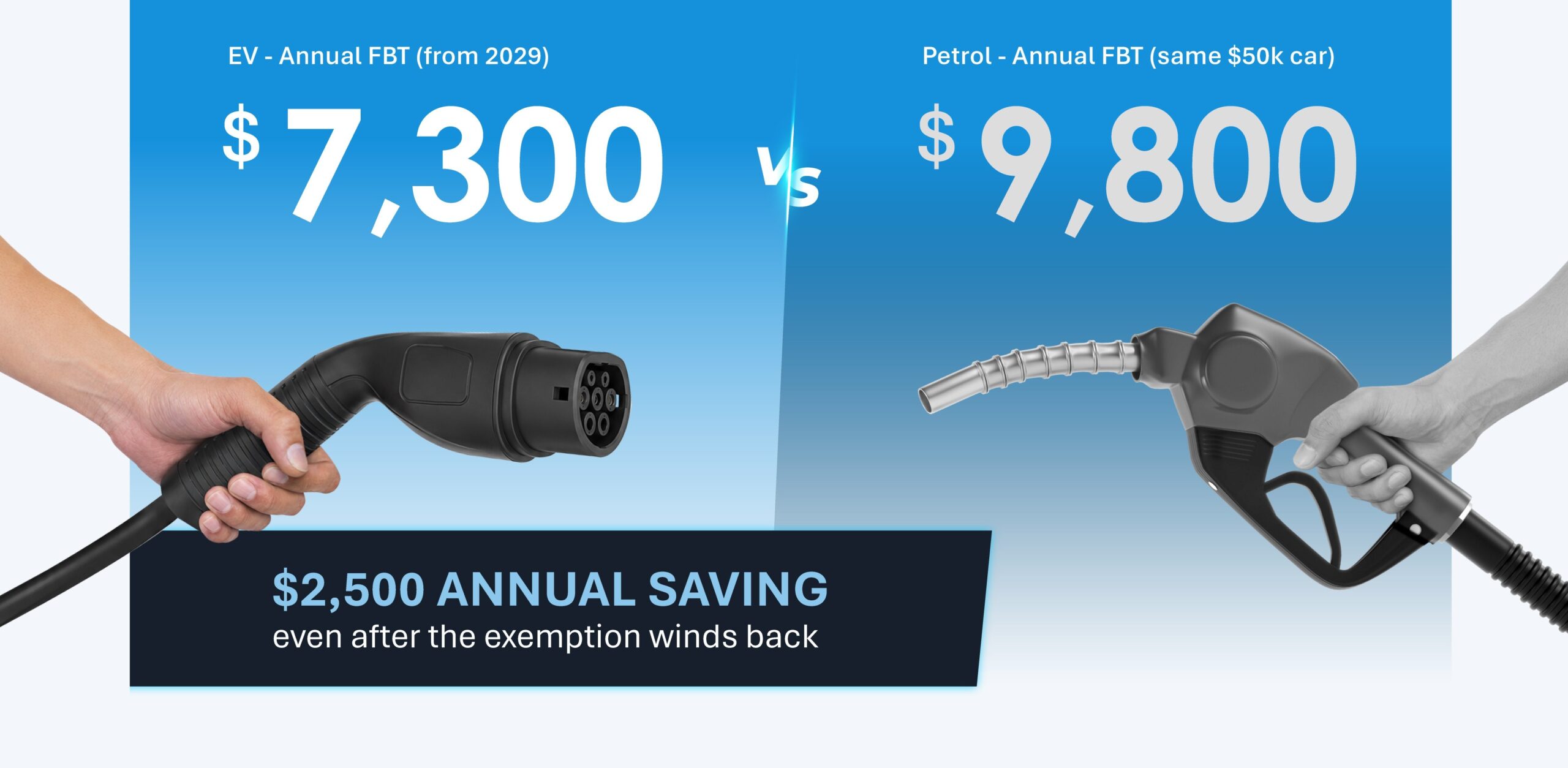
Let’s put this into plain dollar terms. Take a $50,000 car under a novated lease:
- Petrol car: ~$9,800/year in FBT
- EV from 2029: ~$7,300/year in FBT
That’s a $2,500 annual saving even after the exemption winds back.
The EV advantage doesn’t disappear in 2029. It just gets smaller.
Why the Government is making this change
The exemption was always intended as a transitional measure to help EVs reach price parity with petrol vehicles. With over 100,000 Australians already using novated leases to access EVs and with more affordable models entering the market the government is refocusing the discount on vehicles under $75,000 to target mainstream buyers rather than luxury purchases.
Treasurer Jim Chalmers confirmed the phased approach is designed to encourage manufacturers to bring more affordable options to Australia while managing fiscal sustainability.
What this means if you are considering an EV
The message is straightforward: the time to act is now, not later.
If you’re thinking about transitioning your fleet to EVs, or helping employees access EVs through salary sacrifice, the next two years represent the most favourable tax conditions Australia is likely to offer for a long time.
At EVSE Australia, we work with fleet operators, businesses, and EV drivers across Australia and New Zealand to make the transition to electric charging infrastructure as seamless as possible. Whether you’re planning workplace charging, public charging, or home charging to support your employees, we can help you build the right solution.
Get in touch with the EVSE team
Key Takeaways
- The full FBT exemption for EVs under $75k runs until April 2027
- From March 2029, all EVs move to a 75% FBT rate still $2,500/year cheaper than petrol equivalents
- Leases signed before the cutoff are grandfathered locking in today’s rates
- The EV advantage is shrinking, not disappearing
-
Job Title - Co-Founder, EVSE Australia
11 years of EV charging deployment history
EV specialist, ev driver, member of AFMA, AEVA, EV Council, HVIA
Sam Korkees is the Co-Founder of EVSE Australia, a leading provider of electric vehicle (EV) charging infrastructure and solutions. Since co-founding the company in 2014 alongside Brendan Wheeler, Sam has played a pivotal role in scaling EVSE from an early-stage startup into a nationally recognised leader in EV charging.
EVSE has delivered some of the country's largest EV fleet and depot charging deployments, supporting the electrification of commercial fleets, logistics operations, and government assets. The company is also recognised as a leader in public charging infrastructure, with extensive experience in the rollout of fast and ultra-fast DC charging networks nationwide.
Sam works closely with government, utilities, and enterprise clients to design and implement scalable, future-ready charging solutions, helping accelerate the adoption of EVs across Australia.
Credentials: 11 years of EV charging deployment history, EV specialist, EV driver, member of AFMA, AEVA, EV Council, HVIA