As EV adoption accelerates across Australia, more councils, businesses, fleet operators and property owners are moving past the question of whether they need DC fast charging and asking a smarter one: what type of DC charging architecture suits their site?
The answer matters more than it might seem. Choose the wrong setup and you could end up with infrastructure that’s difficult to expand, inefficient with available power, or simply oversized for what your site needs. Choose the right one and your EV charging investment will serve you well for years to come.
This guide breaks down the key differences between standalone DC chargers and satellite DC charging systems and helps you work out which approach is the better fit for your situation.
What Is a Standalone DC Charger?
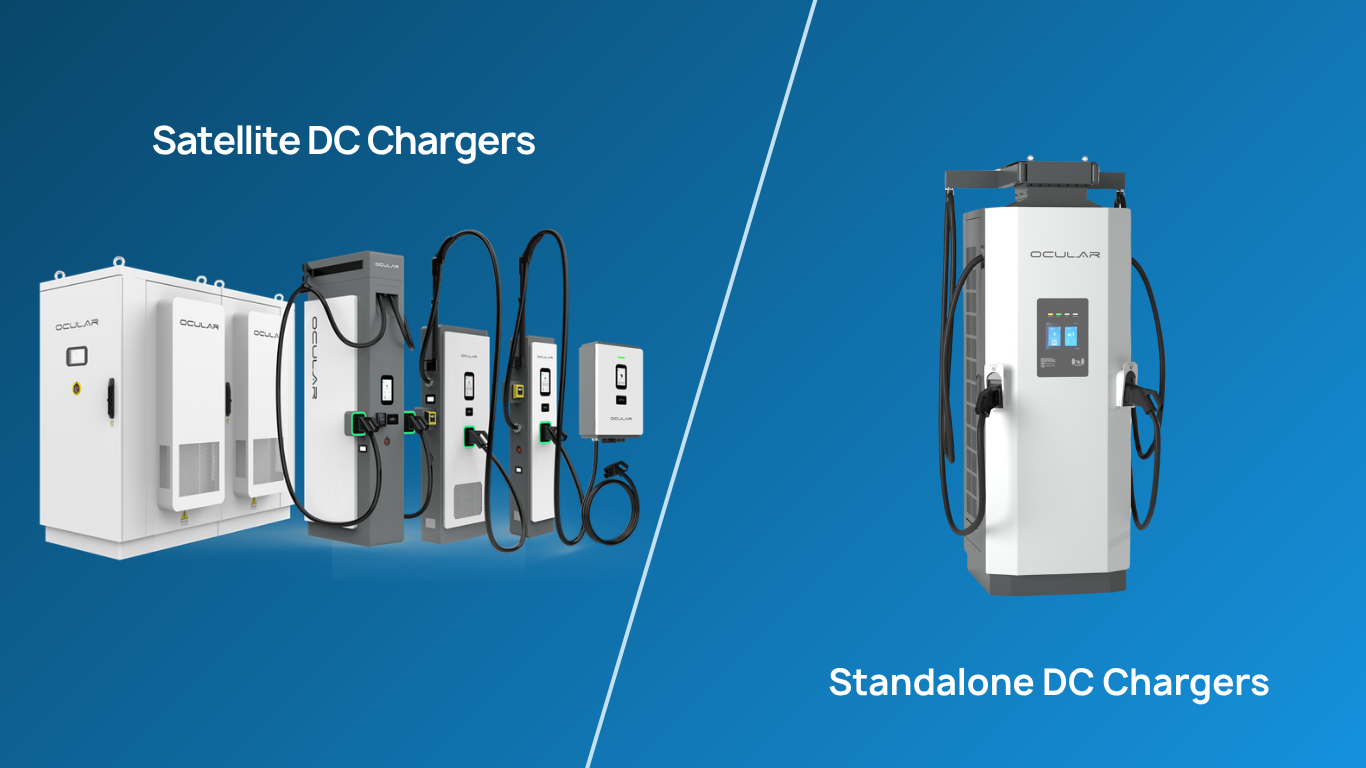
A standalone DC charger is an all-in-one unit. The power electronics, user interface and charging cables are all housed within a single cabinet — plug in, configure and charge.
This type of setup suits sites that need one or two DC fast chargers without complex infrastructure. Common use cases include:
- Commercial car parks
- Retail centres and shopping precincts
- Hotels and accommodation venues
- Councils and community facilities
- Workplaces and corporate campuses
- Small fleet depots
- Dealerships and service centres
- Destination charging sites
Standalone DC chargers are a practical choice when the charging requirement is clear, contained and unlikely to change significantly. If a site needs a single 60kW, 120kW or 180kW charger to serve visitors, staff or a small fleet, a standalone unit will often be the most straightforward and cost-effective option.
What is a Satellite DC Charging system?
A satellite DC charging system separates the main power electronics from the charging dispensers. Rather than packaging everything into each individual charger, the site uses a centralised power cabinet that distributes DC power to multiple satellite dispensers positioned across several bays.
Put simply:
- Standalone DC charger: One cabinet, one or two bays.
- Satellite DC system: One central power system serving multiple dispensers and bays.
This architecture is particularly well-suited to sites where charging demand is higher, bays need to be distributed across a larger area, or the site is expected to grow over time.
When does a Satellite DC system makes more sense?
A satellite system is worth considering when your site has more complex or longer-term charging needs than a simple one or two charger setup
Get in touch with the EVSE team
1. You Need to Charge Multiple Vehicles Simultaneously
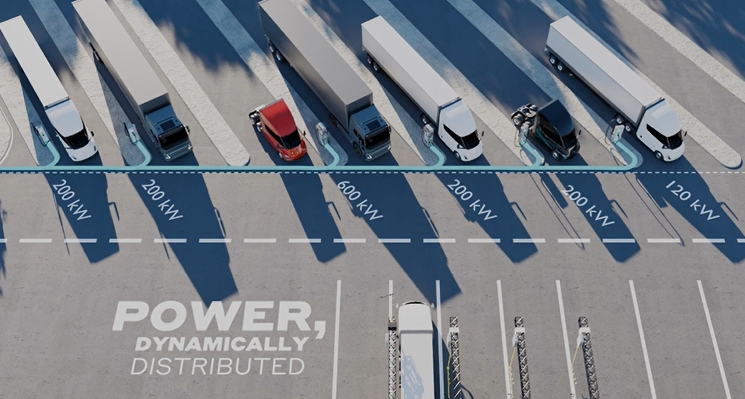
If your site sees several EVs arriving throughout the day — whether fleet vehicles returning from runs, customers at a highway stop or guests at a large hotel — a satellite system allows power to be distributed intelligently across multiple charging bays at once.
This makes satellite DC charging particularly useful for:
- Fleet depots and logistics sites
- Bus, van and commercial vehicle operations
- Highway charging hubs and service stations
- Large public charging sites
- Shopping centres and airport precincts
- Mixed-use and transit-oriented developments
Rather than installing several separate standalone DC chargers, a satellite system enables smarter power sharing across the whole site.
2. You’re Planning for Staged Growth
Many EV charging sites are now designed in stages. A site might only need a handful of bays today but could require many more within two, five or ten years.
A satellite DC system lends itself well to this kind of phased development. The centralised power architecture can often accommodate additional dispensers and bays over time without treating every expansion as a separate installation project.
For businesses that know their EV demand will grow but don’t want to overbuild from day one, this flexibility can be genuinely valuable.
3. Your Available Electrical Capacity Is Limited
One of the most common constraints on DC fast charging isn’t the charger itself it’s the available power supply. Many sites simply don’t have enough spare electrical capacity to give every bay full power simultaneously.
A satellite system can help by sharing available capacity across multiple bays based on real-time demand. Not every vehicle will need maximum power at the same time some may be nearly full; others may have lower onboard charging limits. The system allocates power where it’s needed, helping the site make better use of what’s available rather than requiring each charger connection to be sized individually at full capacity.
4. You Want a Cleaner, More Considered Site Layout
Multiple standalone DC chargers spread across a car park each require their own footprint, protection, cable routes and electrical connections. At larger sites, this can create layout challenges and visual clutter.
A satellite system offers an alternative: the main power equipment is housed in a back-of-house or dedicated electrical area, while the satellite dispensers are positioned close to the parking bays. For sites where presentation, pedestrian movement and bay layout matter such as retail precincts or transport hubs this can be a meaningful advantage.
5. You’re Planning for High-Power or Future Charging Needs
As EV batteries increase in capacity and commercial fleets push toward higher daily energy requirements, some sites will need infrastructure capable of supporting faster turnarounds. A satellite system can provide a stronger platform for scaling to higher power levels across multiple bays over time something that becomes increasingly relevant for highway corridors, public charging hubs and heavy-use fleet operations.
When Is a Standalone DC Charger the Better Choice?
A satellite system is not the right answer for every site. In many cases arguably the majority a standalone DC charger remains the more practical and cost-effective solution.
Consider a standalone DC charger when:
- The site needs only one or two DC chargers
- Power availability is limited and significant future expansion isn’t planned
- The budget doesn’t justify a larger centralised system
- The parking layout is simple and cable routes are straightforward
- Charging is primarily for visitors, customers or light fleet use
- Demand is predictable and relatively low
- A faster, simpler deployment is the priority
If the requirement is simple, the solution should be too.
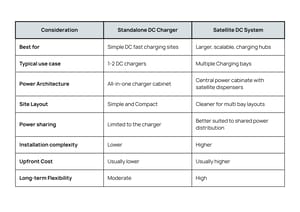
Satellite DC vs Standalone DC: Quick Comparison

A Practical Decision Framework
Still unsure which direction suits your site? Work through these questions:
- How many EVs need to charge at the same time?
- Is the site likely to need more chargers in the future?
- Is this a charging hub or a simpler add-on installation?
- How much electrical capacity is currently available?
- Is high-power charging needed now, or likely to be required in the next few years?
- Is the car park layout simple or spread across a larger area?
- Would a centralised power system make future upgrades more manageable?
If your answers point to one or two chargers with limited growth expected, a standalone DC charger will generally be the right choice. If your answers point to multiple bays, staged growth, higher power needs or a larger fleet or public charging environment, a satellite DC system deserves serious consideration.
Choosing the Right Architecture from the Start
The most expensive EV charging mistake isn’t installing too little or too much it’s installing the wrong type of system for how the site will actually be used.
Getting the architecture right at the outset reduces future upgrade costs, improves the experience for drivers and operators, and makes the charging infrastructure easier to manage over its operational life.
At EVSE, we work with councils, fleet operators, property owners, developers and facility managers to assess site conditions, available power, vehicle use cases, expected demand and future growth plans before recommending the most suitable DC charging solution. Whether your site needs a single standalone unit or a scalable satellite DC system, the goal is always the same: a solution built for today that’s ready for tomorrow.
Get in touch with the EVSE team
-
Job Title - Co-Founder, EVSE Australia
11 years of EV charging deployment history
EV specialist, ev driver, member of AFMA, AEVA, EV Council, HVIA
Sam Korkees is the Co-Founder of EVSE Australia, a leading provider of electric vehicle (EV) charging infrastructure and solutions. Since co-founding the company in 2014 alongside Brendan Wheeler, Sam has played a pivotal role in scaling EVSE from an early-stage startup into a nationally recognised leader in EV charging.
EVSE has delivered some of the country's largest EV fleet and depot charging deployments, supporting the electrification of commercial fleets, logistics operations, and government assets. The company is also recognised as a leader in public charging infrastructure, with extensive experience in the rollout of fast and ultra-fast DC charging networks nationwide.
Sam works closely with government, utilities, and enterprise clients to design and implement scalable, future-ready charging solutions, helping accelerate the adoption of EVs across Australia.
Credentials: 11 years of EV charging deployment history, EV specialist, EV driver, member of AFMA, AEVA, EV Council, HVIA