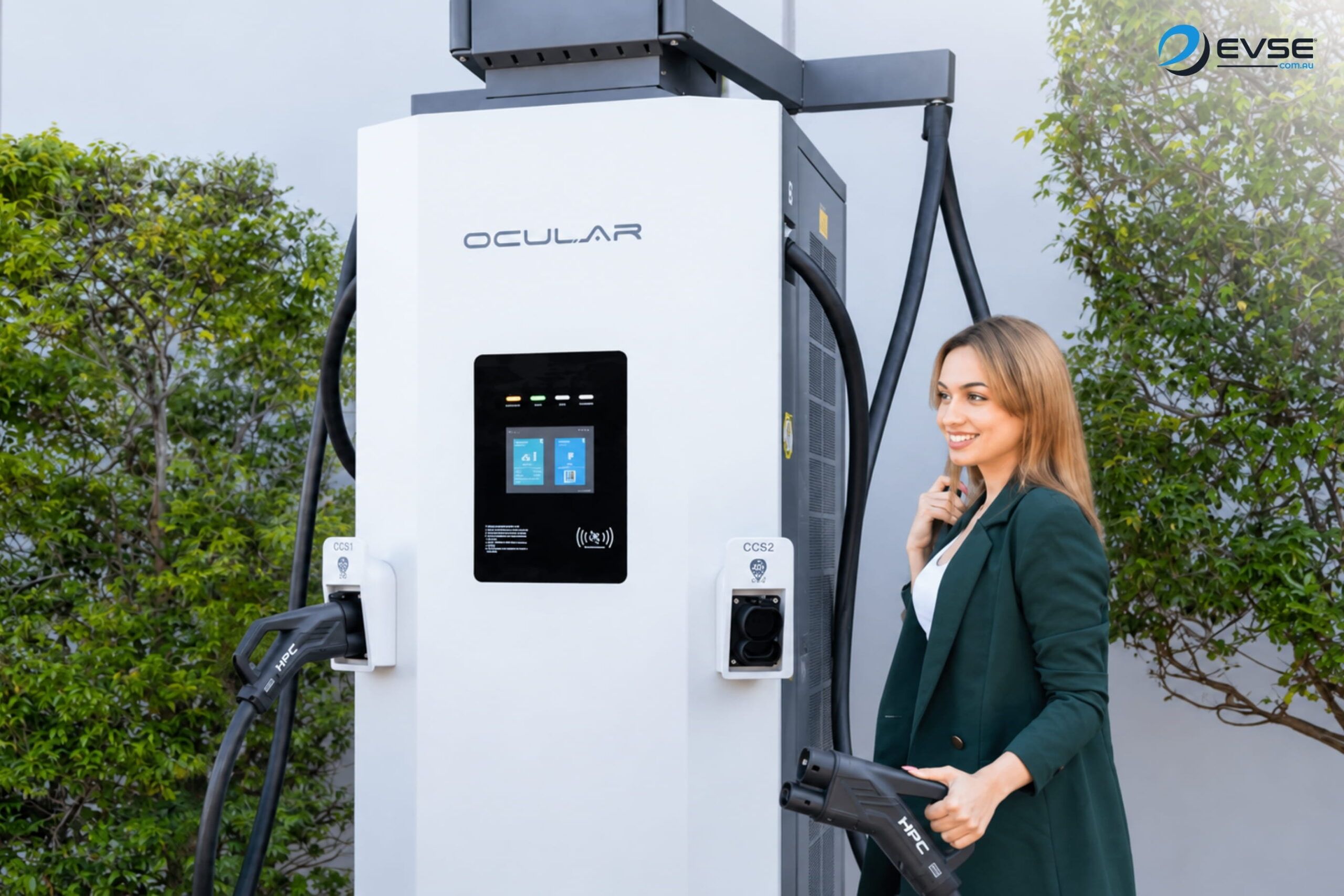
Before any commercial EV charger is installed, the property’s electrical infrastructure needs to be assessed to determine how much additional load it can support. This is not a complex process, but it is a necessary one. Properties that skip this step and install chargers without proper load assessment consistently encounter problems: tripped switchboards, overloaded circuits, unexpected costs for infrastructure upgrades, and in some cases, failed compliance inspections.
This guide explains what an electrical capacity assessment involves, what the outputs mean, and how to use those outputs to make informed decisions about charger quantity, type, and load management.
What Electrical Capacity Assessment Covers
An electrical capacity assessment for EV charging looks at four areas: the existing site load, the switchboard capacity, the incoming supply, and the DNSP (distribution network service provider) connection.
Existing Site Load
Before any EV charger is added to a property’s electrical system, the assessor establishes what the existing load is. This is typically done by reviewing the switchboard’s rated capacity, checking for available circuit space, and, for larger commercial properties, reviewing historical electricity billing data or installing a temporary power monitoring device to capture actual peak demand.
A building’s rated switchboard capacity and its actual average load are different numbers. A 200-amp switchboard in a building that regularly draws 160 amps has 40 amps of available headroom. At 240 volts single phase, that’s approximately 9.6kW of available capacity for EV charging before the switchboard reaches its limit. At 415 volts three phase, the calculation is different.
Switchboard Capacity and Available Circuit Space
The switchboard assessment looks at the physical switchboard: its rated capacity, the number of circuit breakers currently installed, the available space for new circuits, and whether the main incomer is rated for additional load.
Older switchboards in commercial buildings often have limited available circuit space and may not be rated for significant load additions without an upgrade. A switchboard upgrade is a significant but manageable cost item, typically in the range of $5,000 to $40,000 depending on the scope of work required.
Incoming Supply
The incoming supply is the connection from the distribution network to the property. In most commercial properties, this is a three-phase connection rated at a defined amperage. If the building’s demand approaches the incoming supply limit, adding EV chargers without load management or a connection upgrade will cause the main supply protection to trip.
In some cases, particularly older industrial or commercial buildings, the incoming supply may be undersized relative to the building’s current use, let alone EV charging additions. Identifying this early in the project prevents expensive surprises during installation.
DNSP Connection Capacity
The DNSP (Ausgrid, Endeavour, AusNet, Energex, SA Power Networks, Western Power, etc.) owns the infrastructure up to the property boundary. The distribution network itself has capacity limits, and adding a significant new load may require the DNSP to assess whether the local network can support it.
For small installations (one to three 7kW chargers), DNSP notification is usually straightforward. For larger installations (ten or more chargers, or any DC fast charger), a formal connection application may be required, which can take several weeks to several months depending on the DNSP and the specific network conditions at the site.
How Much Load Can My Site Support?
The practical output of an electrical capacity assessment is a number: how many kilowatts of additional continuous load the site can support without any infrastructure upgrades. From there, you can calculate how many chargers are feasible, and at what output rate.
| Available capacity |
Chargers possible (no upgrade) |
| 10kW (single phase) |
1 x 7kW AC charger |
| 30kW (three phase) |
1 x 22kW AC or 3 x 7kW AC |
| 60kW (three phase) |
3 x 22kW AC or 8 x 7kW AC |
| 100kW+ (three phase) |
4+ x 22kW or 1 x DC 50kW |
| 200kW+ (three phase) |
10+ AC chargers or DC 100kW+ |
Load management changes this picture significantly. With active load management, a site with 60kW of available capacity can support more chargers than the table above suggests, because the software prevents all chargers from drawing simultaneously at full rate. A well-configured load management system can allow 1.5 to 2.5 times more charging positions than the available capacity would support on a static allocation basis.
When an Infrastructure Upgrade Is Needed
If the site assessment finds insufficient capacity for the planned charger deployment, there are three options: reduce the number or output rate of chargers to fit within available capacity, upgrade the on-site electrical infrastructure (switchboard, incoming supply), or apply to the DNSP for a connection upgrade.
On-site upgrades are fully within the control of the property owner and can typically be completed within weeks. DNSP connection upgrades are subject to the DNSP’s own assessment and construction timeline, which can add months to the project.
For most commercial properties installing a moderate number of AC chargers, on-site upgrades combined with load management are sufficient without requiring any DNSP involvement. For larger installations, or for properties in areas where the local distribution network is constrained, DNSP engagement is an important early step.
Getting a Site Assessment
EVSE’s commercial team conducts site assessments for commercial EV charging projects across Australia. The assessment covers existing electrical infrastructure, available capacity, DNSP requirements, and a recommended charger specification and load management approach. Contact our commercial team to arrange a site assessment for your property.
An electrical capacity assessment takes a few hours and costs a fraction of what a miscalculated installation costs to rectify. For any commercial EV charging project, it is the correct starting point.
-
Job title / role - CEO
Years of experience in EV charging or electrical work 11 years
Relevant credentials or certifications (e.g. licensed electrician, Clean Energy Council accreditation, EV specialist training, brand certifications) EV specialist, ev driver, member of AFMA, AEVA, EV Council, HVIA
Brendan Wheeler is Co-Founder and CEO of EVSE Australia, a vertically integrated EV charging provider. He leads the rollout of infrastructure across home, workplace and public charging. His focus is on building a connected platform that delivers reliable, commercially sustainable outcomes.