EVSE and Exploren are seeking eligible NSW councils and commercial car park hosts for a CPO-led grant application
The NSW Government has opened Round 3 of the EV Kerbside Charging Grants, with $5 million available to help eligible charge point operators expand public charging in 37 priority local government areas.
EVSE and Exploren are preparing a joint application and are now seeking suitable councils, shopping centres, retail precincts and commercial car park owners that want to host public EV charging at their locations.
If your site qualifies, our team can assess it for inclusion in the application and develop the charging, installation and operating model. The grant is competitive, and neither registration nor a letter of support guarantees that a site will be selected or funded.
Round 3 at a glance
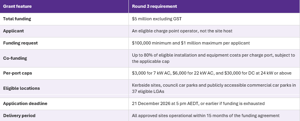
Round 3 is a competitive co-funding program, not an automatic rebate. The NSW Government will assess eligible applications against strategy, experience, delivery capability, financial planning and user experience.
What has changed in Round 3
Round 3 creates a broader opportunity for site hosts than the previous round. The program now covers 37 eligible LGAs, adds commercial car parks as an eligible installation type and replaces the former location-zone caps with charger-specific caps for 7 kW AC, 22 kW AC and DC chargers rated at 24 kW or above.
This means a qualifying retail or commercial property can now be considered alongside kerbside and council-owned locations, provided its parking spaces are genuinely available to the public and the project meets the program requirements.
Who should register a location
EVSE and Exploren want to hear from organisations with sites in an eligible LGA, including:
– NSW councils with suitable kerbside locations or publicly accessible council car parks
– shopping centres, supermarkets and retail precincts
– owners and operators of publicly accessible commercial car parks
– mixed-use or commercial properties with visitor parking that is not restricted to residents, staff or tenants
– multi-site property groups that can nominate several locations across one or more eligible LGAs
For a car park to qualify, the spaces must be available to visitors to the premises and the charging site must be open to the public for at least 12 hours a day, seven days a week. Kerbside locations must be available 24 hours a day, seven days a week, except for dedicated car-share spaces.
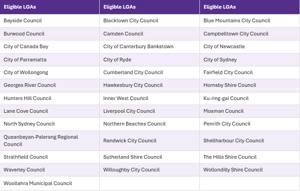
The 37 eligible local government areas

What the grant can help fund
Eligible expenditure is focused on the infrastructure required to build the site. It can include:
– EV charger hardware and electrical protection components
– civil and electrical design and installation works
– cabling, new circuits, submetering and upgrades to existing electrical infrastructure
– electricity network connection fees and facilities access agreements where required
– data cabling, modems and other equipment needed to connect chargers to the internet
– energy management systems and load management equipment
– regulatory signage, pavement and bay marking, bollards, wheel stops and lighting
– eligible planning, approval and council application fees
The grant does not fund every project cost. Ineligible items include grant application costs, feasibility studies, business cases, project management, software subscriptions, internet and data charges, electricity, maintenance, ongoing lease costs and marketing. The final commercial model therefore needs to account for both the required private contribution and the costs of operating the chargers over time.
What a site host needs to provide
At the application stage, car park locations require an exact site address and a signed letter of support from the site host. The letter must confirm that the site can support installation within the 15-month delivery period, will not be affected by planned redevelopment within five years, will provide dedicated EV charging bays and will be publicly accessible for at least 12 hours a day, seven days a week.
Kerbside proposals require a letter of support from each relevant council stating the intended number of sites. Exact kerbside addresses are not required at application, but successful CPOs must later secure council agreement for each confirmed site.
A letter of support is not a final lease or licence and does not guarantee funding. It demonstrates that the host understands the proposal and is willing to work with the CPO through site investigation, approvals and delivery.
The operating requirements matter as much as the charger
Round 3 is designed to create reliable public charging infrastructure, not simply install hardware. Funded sites must meet detailed technical and operating requirements, including:
– OCPP-compatible chargers with minimum power ratings of 7 kW AC or 24 kW DC
– remote charger management and public visibility of charger availability
– 24/7 customer support and ongoing maintenance arrangements
– minimum availability and reporting obligations across the co-funded network
– 100% renewable electricity for charging, maintained in perpetuity
– clear pricing, public location listings and NSW Government funding acknowledgement
– safe, accessible site design that considers people with disability
– contactless credit and debit card payment for DC chargers rated at 24 kW or above
This is why selecting an experienced CPO is important. The application must show how the network will be supported, monitored, maintained and reported on for the long term.
Why EVSE and Exploren
EVSE and Exploren bring the physical and digital parts of public charging together. EVSE delivers public EV charging infrastructure, including site assessment, electrical and civil design, hardware, installation, commissioning and maintenance. Exploren provides the public charging network and CPO capability, including driver access, payments, charger monitoring, customer support and ongoing network operations.
The Exploren reporting platform provides the operational and usage visibility needed to manage public charging sites. The proposed solution will also be designed around the grant’s required public availability and government reporting obligations.
For site hosts, this creates one coordinated pathway from initial site screening and grant preparation through to installation and long-term operation. The ownership, funding contribution, host revenue and operating arrangements for each site will be confirmed through feasibility assessment and a separate commercial agreement.
How to put your site forward
- Confirm that the property is within one of the 37 eligible LGAs.
- Check that the car park can provide public access for at least 12 hours a day, seven days a week, or that the kerbside location can remain publicly available 24/7.
- Send EVSE the site address, operating hours, approximate parking numbers, available electrical information and any site plans or photos you have.
- EVSE and Exploren will complete an initial suitability and commercial screening.
- If the site is shortlisted, we will work with you on the required letter of support and the information needed for the CPO application.
The grant closes on 21 December 2026 at 5 pm AEDT, or earlier if funding is exhausted. Site review, network checks, budget development and host documentation take time, so interested organisations should contact us well before the closing date.
Register your site with EVSE and Exploren
If you own or manage an eligible NSW location and want to explore becoming a public EV charging site host, contact EVSE Australia or call 1300 406 210. Our team will assess whether the site may be suitable for inclusion in the EVSE and Exploren Round 3 application.
You can also learn more about hosting EV chargers with Exploren and EVSE’s council and government charging solutions.
Official grant information
NSW Government Round 3 grant page
Round 3 funding guidelines
Round 3 frequently asked questions
NSW guidance for public EV charging site hosts
Important: Grant settings, guidance and deadlines may change. Site participation is subject to eligibility, technical and commercial assessment, host agreement, a successful funding application and execution of the relevant project agreements. This article is general information and does not replace the official grant guidelines.
Frequently asked questions
Round 3 is open to eligible charge point operators. A council or property owner can participate as a site host and support a CPO's application.
Not necessarily. NSW Government co-funding is limited to 80% of eligible installation and equipment costs per charge port and is also subject to the applicable per-port cap. Operating and other ineligible costs must be funded seperately.
Yes. Parking must be available to visitors, and the charging site must be open to the public for at least 12 hours a day, seven days a week. Resident-only, tenant-only or staff-only parking does not satisfy the car park requirements.
For council and commercial car park installations, the exact address and a site-host letter of support are required. Kerbside applications can nominate a number of sites within an LGA before exact addresses are finalised, supported by the relevant council.
The program supports AC charging from 7 kW and DC chargers from 24 kW. The correct mix depends on site dwell time, electrical capacity, driver demand and project economics.
No. The site must pass EVSE and Exploren's assessment, be included in the final application, receive NSW Government approval and proceed under agreed commercial and site-access terms.
-
Job title / role - CEO
Years of experience in EV charging or electrical work 11 years
Relevant credentials or certifications (e.g. licensed electrician, Clean Energy Council accreditation, EV specialist training, brand certifications) EV specialist, ev driver, member of AFMA, AEVA, EV Council, HVIA
Brendan Wheeler is Co-Founder and CEO of EVSE Australia, a vertically integrated EV charging provider. He leads the rollout of infrastructure across home, workplace and public charging. His focus is on building a connected platform that delivers reliable, commercially sustainable outcomes.