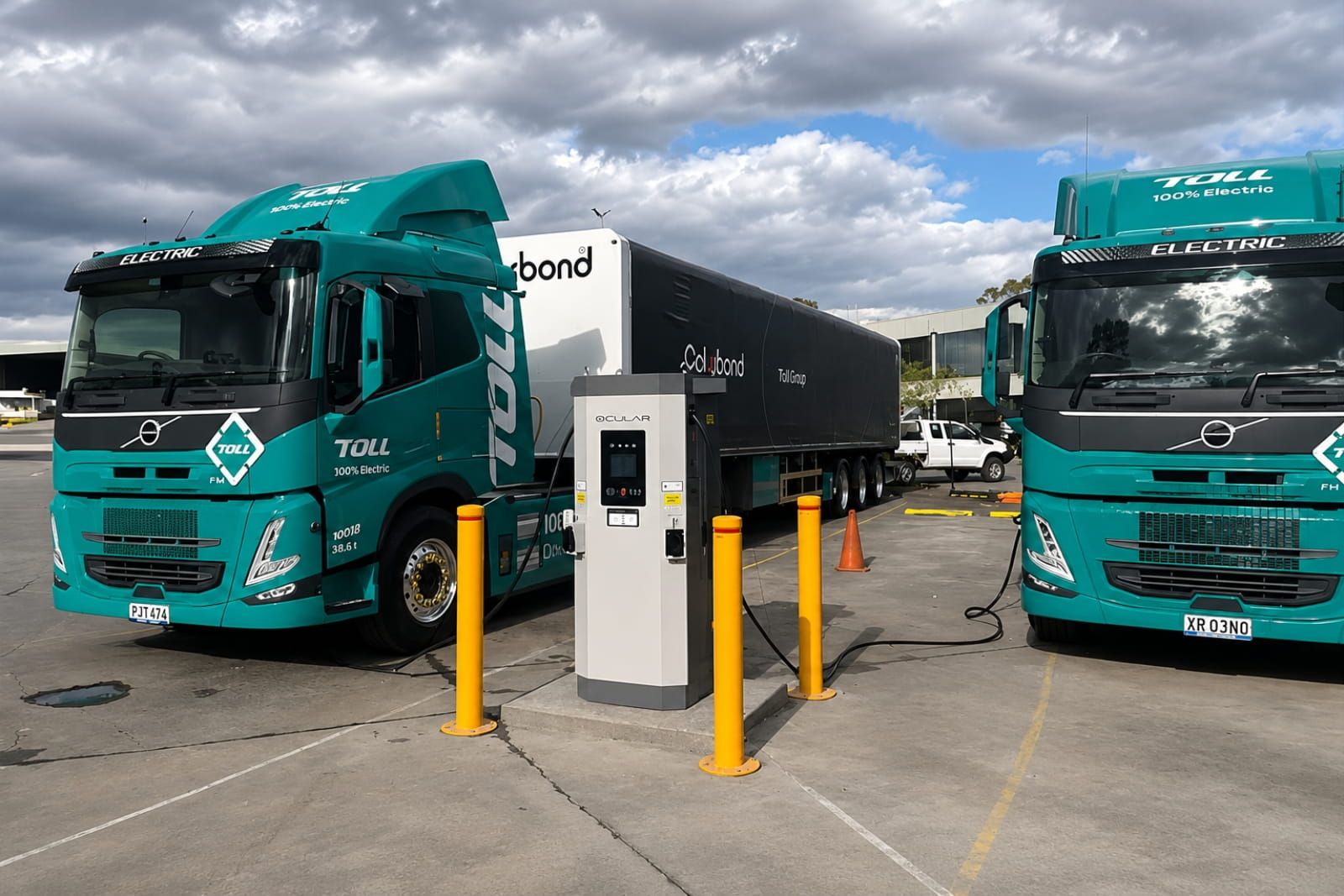
In the catalogue of Australian fleet electrification projects, Toll Group’s TruckVolt program stands apart, not because it was the first to deploy battery electric heavy vehicles, but because of its scale, its commercial ambition, and what it demonstrated about the infrastructure requirements of serious long-haul logistics electrification.
The $67 million investment, supported by ARENA funding, deployed 28 battery electric vehicles, Volvo FH and FM prime movers, across ten distribution centres and customer sites nationally. It wasn’t a pilot. It wasn’t a trial to generate data for a future decision. It was a deliberate commitment to electrifying a meaningful portion of Toll’s metropolitan and short-haul operations, with the explicit intention of learning what it takes to scale from there to long-haul.
This article uses TruckVolt as the central reference point for understanding what prime mover electrification looks like at commercial scale in Australia, the infrastructure requirements, the operational constraints, the role of Megawatt Charging System technology in closing the long-haul gap, and what the trajectory toward zero-emission logistics actually looks like from where we are now.
What TruckVolt Actually Involved
The Vehicles
The Volvo FH and FM battery electric prime movers deployed in TruckVolt carry battery capacities in the range of 540 to 660kWh depending on configuration. At Australian highway speeds and payload weights, this translates to operational range of approximately 300 to 400km per charge, suitable for metropolitan distribution, regional hub-to-hub movements, and short-to-medium haul operations, but not yet for interstate long-haul in a single charge.
The vehicles are equipped with CCS2 charging capability rated up to 250kW DC. At that rate, a full charge from depleted takes approximately two to three hours. A partial charge, from 20 to 80 percent, takes around ninety minutes. For depot-based operations where vehicles return overnight, this is workable. For operations requiring mid-route charging, it creates scheduling constraints that diesel operations don’t face.
The Infrastructure Across Ten Sites
Ten sites nationally meant ten separate grid feasibility assessments, ten DNSP engagements, and ten sets of civil and electrical works. Each site had its own electrical infrastructure condition, its own network connection capacity, and its own physical layout constraints.
The infrastructure at each site was designed around the specific vehicle count and operational schedule at that location. Sites handling three or four vehicles required relatively modest infrastructure upgrades. Sites handling eight to ten vehicles required more significant works, including in some cases switchboard replacements and DNSP connection upgrades. The OCPP-based load management platform was configured to treat all ten sites as a unified managed network, with central visibility but site-level autonomous load management.
What Was Learned
The operational data from TruckVolt’s first twelve months of operation produced several findings relevant to any operator planning prime mover electrification.
- The grid feasibility timeline was consistently the critical path at sites requiring DNSP engagement. Sites where infrastructure works could begin without DNSP augmentation were operational six to eight months ahead of sites requiring network upgrades.
- Energy costs were significantly below diesel equivalents for all metropolitan and short-haul operations, confirming the financial model but also highlighting the importance of off-peak tariff access for overnight charging.
- Driver adaptation was faster than anticipated for depot operations but required more attention for drivers transitioning from long-haul routes to the shorter operational range of current BEV prime movers.
- Maintenance interventions in the first twelve months were substantially lower than the equivalent diesel fleet, consistent with international experience but confirming it in Australian operating conditions.
The Long-Haul Gap and How MCS Closes It
The constraint that prevents current battery electric prime movers from operating on Australian interstate long-haul routes is not primarily range, it’s charging time. A truck covering the Sydney-Melbourne corridor (900km) needs to charge mid-route. At 250kW CCS2, a charging stop that restores 300km of range takes approximately sixty to ninety minutes. That’s a commercially unacceptable addition to a trip that takes roughly nine hours under diesel power.
Megawatt Charging System changes this calculation. At 1MW, which is within the current range of commercially available MCS hardware, the same 300km range restoration takes fifteen to twenty minutes. At 2MW, the theoretical upper end of current hardware deployment, it falls to eight to ten minutes. Either figure is compatible with mandatory rest break requirements under Australian heavy vehicle driver fatigue legislation.
| Route: Sydney to Melbourne |
~900km |
| BEV prime mover range (current) |
300 to 400km per charge |
| Mid-route charge required |
Yes (1 stop) |
| CCS2 (250kW): range top-up time |
60 to 90 minutes |
| MCS (1MW): range top-up time |
15 to 20 minutes |
| MCS (2MW): range top-up time |
8 to 10 minutes |
| Mandatory rest break (AU HV legislation) |
30 min after 5.5 hours, 45 min after 7 hours |
| Conclusion |
MCS makes charging compatible with mandatory rest breaks |
The implication is that long-haul zero-emission logistics in Australia is not waiting on a fundamental battery breakthrough. It’s waiting on two things: MCS-capable vehicles reaching the Australian market at commercial scale, and MCS charging infrastructure being deployed at the key points on major freight corridors.
MCS-Capable Vehicles: The Australian Timeline
Scania has confirmed MCS-capable battery electric prime movers from mid-2026. Volvo and Daimler Truck are at various stages of MCS vehicle development, with Australian market availability expected from late 2026 to 2027. Traton Group brands (MAN, Scania) are investing heavily in MCS capability, reflecting European regulatory pressure for zero-emission HV from 2030.
For Australian logistics operators planning their electrification trajectory, the practical implication is that the vehicles required for long-haul zero-emission operations will be available within two to three years. The infrastructure required to support them needs to be in planning now.
Corridor Infrastructure: The Public-Private Challenge
Unlike depot charging, which is funded and managed by the fleet operator, corridor charging on public freight routes requires a different model. The operator of a public MCS charging facility on the Hume Highway needs to build business case on charging revenue from multiple operators, not just its own fleet.
The economics of public MCS corridor charging in Australia are not yet established. The capital cost of a single MCS charging position, hardware, civil works, grid connection, possibly a dedicated substation, runs to $500,000 to $2 million. At current truck volumes on Australian freight corridors, the payback period for that investment at market charging rates is long. Government co-investment, through ARENA’s Driving the Nation fund or equivalent programs, is likely necessary to make the first generation of public MCS corridor infrastructure viable.
This is the pattern that has played out in the US and Europe: early public charging infrastructure requires public support to be economically viable, subsequent infrastructure builds as utilisation demonstrates commercial returns, and the system becomes self-sustaining as vehicle volumes grow. Australia is at the beginning of this curve for heavy vehicle corridor charging.
The Transition Strategy for Australian Logistics Operators
Phase 1: Metropolitan and Regional Hub Electrification
The commercially viable immediate opportunity is metropolitan distribution and regional hub-to-hub operations, exactly the operational profile that TruckVolt targeted. These operations fit within current battery range, can be served by depot-based overnight charging, and generate the energy and maintenance savings that make the financial case work.
For operators with mixed fleets, some routes suitable for electrification now, others requiring long-haul capability, the transition strategy is to identify which vehicles and routes can be electrified today and begin there, while designing the depot infrastructure to accommodate MCS charging when the longer-haul vehicles arrive.
Phase 2: MCS-Ready Depot Infrastructure
The infrastructure decision that separates operators who will transition smoothly to Phase 2 from those who won’t is whether the depot infrastructure built for Phase 1 can accommodate MCS charging with hardware upgrades alone, or requires civil and electrical rebuilds.
MCS at 1MW requires a high-current supply from the depot’s distribution system that standard AC charging infrastructure doesn’t provision for. But the substation, HV cable routes, and main switchboard that a large Phase 1 depot needs can be designed with MCS capability in mind, with spare cable capacity, switchgear rated for higher current, and substation transformer capacity that accommodates the MCS load growth.
The incremental cost of future-proofing a Phase 1 depot for MCS is a fraction of the cost of rebuilding infrastructure that wasn’t designed for it. This decision needs to be made at the Phase 1 design stage, not after the vehicles arrive.
Phase 3: Long-Haul Operations
Phase 3, genuinely zero-emission long-haul operations, depends on factors partly outside any individual operator’s control: MCS corridor infrastructure on key freight routes, MCS-capable vehicle availability, and potentially battery energy density improvements that extend the between-charge range. The likely timeline is 2028 to 2032 for operations on Australia’s major freight corridors to be supportable with zero-emission vehicles, assuming MCS infrastructure investment begins in 2025 to 2026.
Operators that begin Phase 1 now will have the operational experience, the infrastructure foundation, and the organisational capability to execute Phase 3 when the conditions are in place. Those that wait for Phase 3 conditions before beginning will face a compressed transition timeline in a market where skilled electrical contractors, DNSP connection slots, and grid capacity are in high demand.
The window for competitive advantage in fleet electrification is real and finite. Toll’s TruckVolt investment positioned the company as the operational leader in heavy vehicle electrification in Australia, with the data, the infrastructure, and the organisational learning that competitors without a Phase 1 programme will have to develop from scratch. That lead is worth something, and it compounds.
What Other Operators Can Take from TruckVolt
The most transferable lessons from TruckVolt are not technical, they are organisational and process-based.
- Start the infrastructure conversation at the same time as the vehicle conversation, not after. DNSP timelines don’t compress regardless of how much commercial pressure is applied.
- Design the infrastructure for the Phase 2 fleet, not just the Phase 1 fleet. The additional cost of future-proofing is small compared to the cost of rebuilding.
- Treat the charging management platform as an operational system, not an IT peripheral. The integration between charging management and fleet scheduling is where operational value is created or lost.
- The financial model is strong for the right operations. Know which of your operations fit the current range and charging profile, and start there. Don’t wait for a perfect solution to all routes before beginning anywhere.
Prime mover electrification in Australia is not a future scenario. It is a present commercial reality for metropolitan and regional operations, and an approaching reality for long-haul as MCS infrastructure and vehicle availability converge. The operators making infrastructure and organisational decisions now are the ones who will be ready when that convergence arrives. The ones waiting for certainty will be playing catch-up in a market that will not slow down for them.
-
Job Title - Co-Founder, EVSE Australia
11 years of EV charging deployment history
EV specialist, ev driver, member of AFMA, AEVA, EV Council, HVIA
Sam Korkees is the Co-Founder of EVSE Australia, a leading provider of electric vehicle (EV) charging infrastructure and solutions. Since co-founding the company in 2014 alongside Brendan Wheeler, Sam has played a pivotal role in scaling EVSE from an early-stage startup into a nationally recognised leader in EV charging.
EVSE has delivered some of the country's largest EV fleet and depot charging deployments, supporting the electrification of commercial fleets, logistics operations, and government assets. The company is also recognised as a leader in public charging infrastructure, with extensive experience in the rollout of fast and ultra-fast DC charging networks nationwide.
Sam works closely with government, utilities, and enterprise clients to design and implement scalable, future-ready charging solutions, helping accelerate the adoption of EVs across Australia.
Credentials: 11 years of EV charging deployment history, EV specialist, EV driver, member of AFMA, AEVA, EV Council, HVIA