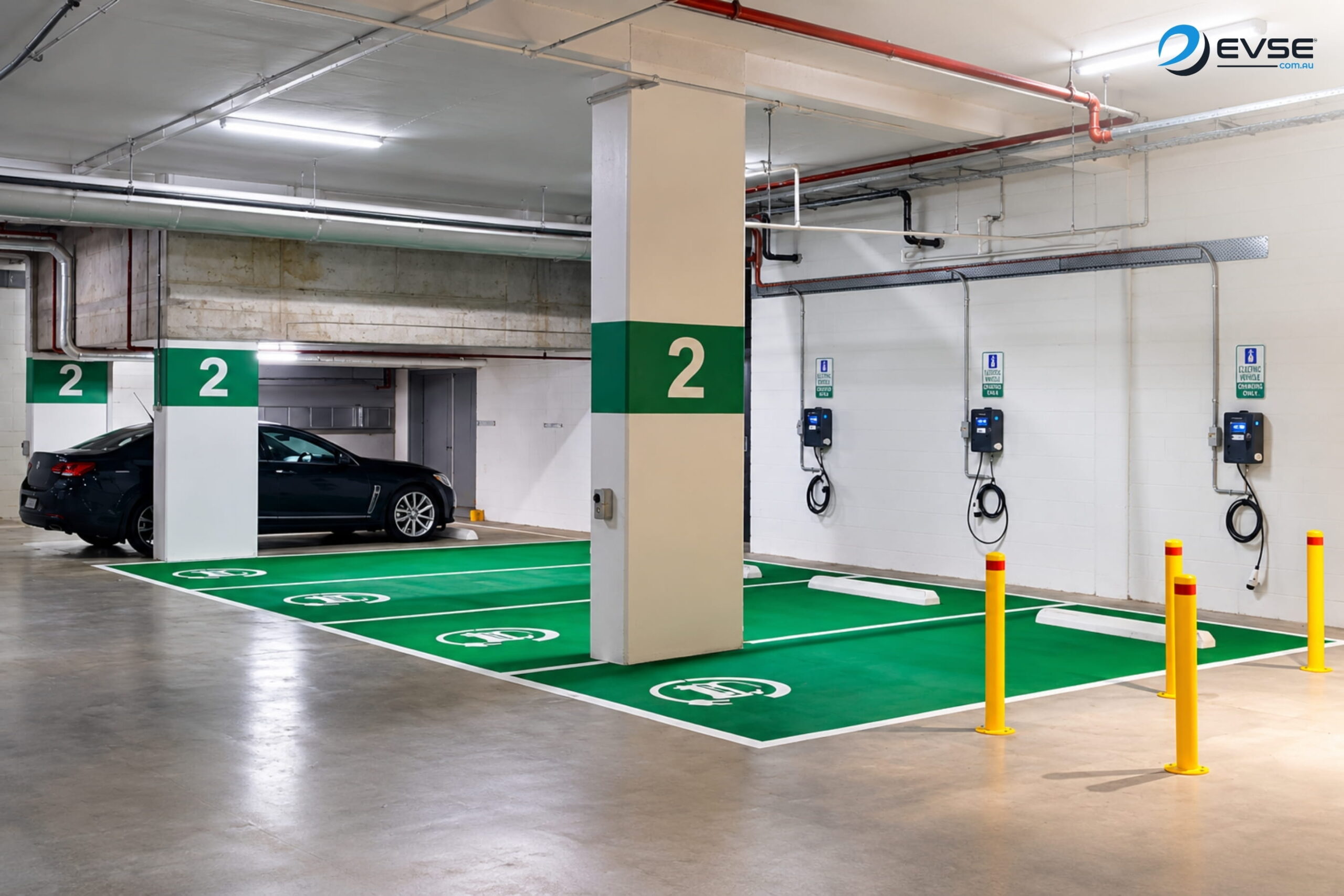
The right EV charger for an office, retail property or shopping centre depends largely on how long vehicles stay parked and what you want charging to achieve. EVSE can supply AC and DC commercial EV charger solutions with software, access control, payments and load management, allowing property owners to match charging speed to customer, employee and tenant needs.
A charger that makes sense for an employee parked for eight hours may be too slow for a supermarket customer visiting for 45 minutes. Conversely, installing high-powered DC chargers where vehicles remain parked all day may add cost and electrical demand without delivering meaningful additional value.
Which EV Charger Suits an Office or Retail Space?
Offices and long-stay parking generally suit smart AC charging, while retail and hospitality EV charging environments with shorter visits may benefit from a combination of AC and DC charging. EVSE recommends assessing dwell time, user type, electrical capacity, expected demand and the business model before choosing charger speed.
| Site type |
Typical parking pattern |
Potential charging approach |
Why it may suit |
| Office staff parking |
Long-stay, often most of the workday |
7 kW to 22 kW smart AC |
Vehicles have several hours available to charge |
| Office visitor parking |
Short to medium stay |
Smart AC or selected faster charging |
Balances convenience with likely visit duration |
| Supermarket or retail |
Short to medium customer visits |
AC plus selected DC fast charging |
Provides options for different dwell times |
| Shopping centre |
Mixed dwell times and high turnover |
Mix of AC and DC |
Can serve longer visits and customers seeking faster charging |
| Hotel and hospitality |
Several hours or overnight |
Smart AC, with faster charging where justified |
Charging can align with guest dwell time |
| Medical/professional suites |
Short to medium appointments |
Smart AC or selected faster charging |
Can provide useful top-up charging during appointments |
Where vehicles return to the same site for several hours, charging can often be planned around those dwell periods. Home charging may suit tool-of-trade vehicles used by sales representatives, technicians or other employees who keep a company vehicle overnight.
Why Does Dwell Time Decide the Charger?
Dwell time matters because the longer a vehicle remains parked, the less charging power may be required to deliver a useful amount of energy. EVSE can assess expected parking duration alongside vehicle demand and electrical capacity so charger speed matches the way the property is actually used.
An office employee may leave a vehicle parked for most of the day, giving an AC charger hours to add range. A retail customer may stay for a much shorter period and value a faster energy top-up. The objective is to provide useful charging without automatically specifying the highest-powered charger available.
Should Retail Sites Use AC or DC Fast Charging?
Retail sites do not automatically need DC fast charging. AC charging can work well where customers remain parked for longer periods, while DC charging can be valuable where faster turnover, shorter visits or a stronger charging destination proposition justifies the additional infrastructure. EVSE can assess whether AC, DC or a mixed deployment best fits the site.
DC charging typically requires greater electrical capacity and can involve higher infrastructure costs. The commercial case therefore needs to consider expected utilisation, customer dwell time, charging tariffs, site capacity and the role charging plays in the property’s overall customer experience.
Should You Charge Customers to Use EV Chargers?
Commercial EV charging can be offered free, charged to users or operated through a hybrid model. EVSE’s charging management solutions can support access control and billing, allowing property owners to choose a model that suits their customers, tenants and commercial objectives.
A workplace might provide free charging to selected employees but charge visitors. A shopping centre could offer a complimentary period before applying a tariff. A retail property may choose paid charging to recover operating costs or create an additional revenue stream.
The right model depends on what the property wants charging to achieve. Free charging can be positioned as an amenity, while paid charging can support cost recovery. In some retail environments, charging may also encourage customers to spend more time at the property while their vehicle charges.
How Does Load Management Protect Your Car Park?
Load management controls the amount of electricity allocated to EV charging so chargers operate within the power available at the building. EVSE’s Exploren platform supports static, active and scheduled load management, which can help commercial properties add charging without allowing every charger to draw maximum power at the same time.
Commercial properties already have substantial electrical loads from lighting, lifts, HVAC, refrigeration, kitchens and other equipment. EV charging adds another variable load. Active load management can adjust charging according to available site capacity, helping the property use its electrical infrastructure more efficiently.
What Software and Payments Do Offices and Retail Sites Need?
Commercial charging software should allow property managers to control who can charge, monitor charger performance, set tariffs where applicable and report on energy use. EVSE’s Exploren platform provides OCPP-compatible software charger management, access control, reporting, billing capabilities and load management across compatible charging infrastructure.
- OCPP-compatible charger management.
- User and access control.
- Tariff configuration where paid charging is required.
- Charging-session and energy-use reporting.
- Remote monitoring and fault visibility.
- Load management.
- Support for multiple sites or car parks.
- Branding and customer-experience options where applicable.
Payment design should also reflect the users. An employee charging program may use authenticated access, while a public-facing retail charger needs a straightforward way for casual drivers to start and pay for a session.
Can EV Charging Generate Revenue for a Retail Property?
Yes, EV charging can be configured as a paid service where the chosen hardware, software and payment model support it. EVSE can help property owners establish tariffs and charging access while considering electricity costs, utilisation and the customer experience.
Revenue should not be considered in isolation. Property owners may also value charging because it improves amenities, supports sustainability objectives, attracts EV drivers or increases the time customers spend on site.
A hybrid model can sometimes balance these goals, such as offering a complimentary charging allowance before applying a tariff or providing different access arrangements for staff, tenants and visitors.
What Does Commercial EV Charging Cost and Are Grants Available?
Commercial EV charging costs vary according to charger type, electrical capacity, switchboard requirements, cabling, civil works, software and the number of parking bays being equipped. EVSE recommends a site-specific assessment rather than relying on a standard installation price.
Government and industry incentives may sometimes support charging infrastructure, but programs change over time and eligibility varies. EVSE maintains information about EV charging incentives that businesses can review when planning a project.
What Do Real Commercial EV Charging Projects Look Like?
The supplied brief identifies Harvey Norman sites delivered with CBRE and the Sheraton Grand Sydney Hyde Park as relevant EVSE commercial examples. These projects can demonstrate how charging requirements change between retail and hospitality environments.
Who Pays for EV Charging at Work?
Workplace charging can be funded by the employer, employee, building owner or another party depending on the property’s charging policy. EVSE’s management software can support different access and billing arrangements, allowing organisations to create a charging model that fits their workplace.
For a more detailed discussion of employer-paid, employee-paid and mixed workplace charging models, link this section to EVSE’s existing knowledge hub article covering who pays for EV charging at work.
How Should a Business Choose Its Commercial EV Chargers?
Start with the people who will use the chargers and how long their vehicles will be parked. EVSE can then assess electrical capacity, expected utilisation, charging speed, payments, software and future expansion, guiding you through the commercial quote process before recommending a commercial charging design.
- Who will use the chargers: employees, tenants, customers, visitors or the public?
- How long do vehicles normally stay parked?
- How many charging bays are needed now and in future?
- Is charging intended as a free amenity, paid service or both?
- What electrical capacity is available?
- Is load management required?
- Does the site need public payment capability?
- How will charging use and revenue be reported?
Frequently Asked Questions
How many EV chargers does an office need?
There is no standard number. Charger quantity should reflect employee demand, parking duration, expected EV adoption, charger-sharing opportunities and available electrical capacity.
Can tenants use a building’s EV chargers?
Yes. Smart commercial charging can support controlled access for different user groups. The exact access and billing model should be agreed between the building owner, manager and tenants.
Do I need DC fast charging for a shopping centre?
Not always. DC charging may suit shorter visits or a fast-charging destination strategy, while AC charging can work well for customers who remain parked longer. Many sites may benefit from a mix.
Can I earn revenue from EV charging?
Paid charging can generate charging revenue where the hardware and software support billing. The commercial model should also account for electricity costs, utilisation and the wider value of the customer amenity.
How long does commercial EV charger installation take?
Timeframes vary according to site assessment, charger quantity, electrical upgrades, approvals, civil works and equipment availability. EVSE can provide a project-specific timeframe after assessing the site.
-
Job Title - Co-Founder, EVSE Australia
11 years of EV charging deployment history
EV specialist, ev driver, member of AFMA, AEVA, EV Council, HVIA
Sam Korkees is the Co-Founder of EVSE Australia, a leading provider of electric vehicle (EV) charging infrastructure and solutions. Since co-founding the company in 2014 alongside Brendan Wheeler, Sam has played a pivotal role in scaling EVSE from an early-stage startup into a nationally recognised leader in EV charging.
EVSE has delivered some of the country's largest EV fleet and depot charging deployments, supporting the electrification of commercial fleets, logistics operations, and government assets. The company is also recognised as a leader in public charging infrastructure, with extensive experience in the rollout of fast and ultra-fast DC charging networks nationwide.
Sam works closely with government, utilities, and enterprise clients to design and implement scalable, future-ready charging solutions, helping accelerate the adoption of EVs across Australia.
Credentials: 11 years of EV charging deployment history, EV specialist, EV driver, member of AFMA, AEVA, EV Council, HVIA