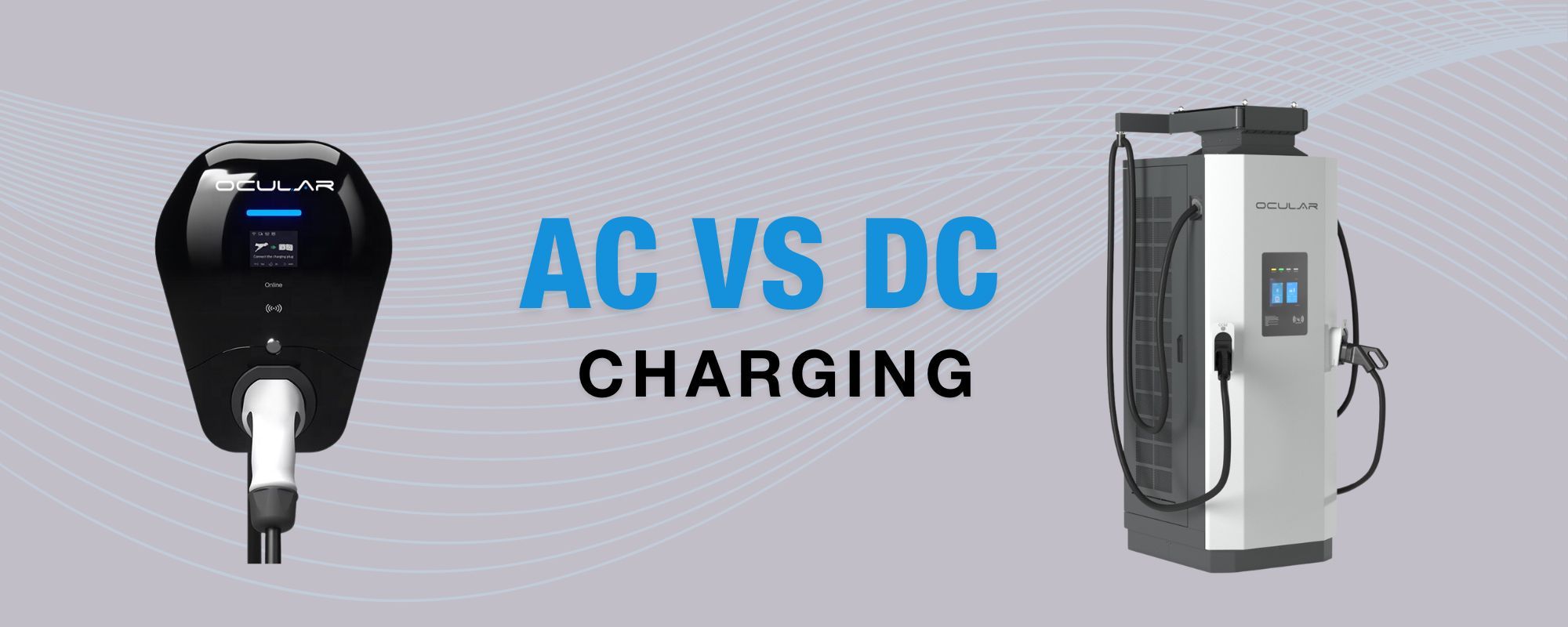
Are you planning to buy an EV? If yes, you need to know the vehicle charging options and dos and don’ts of balancing the cost and charging speed. When it comes to choosing between an AC and a DC charger, there are some fundamental concepts to know:
AC vs. DC Chargers: How AC (Alternating Current) and DC (Direct Current) chargers supply electricity to your EV’s battery is a crucial distinction between them.
The most popular kind of home charger is the AC charger. Here, the car’s inverter receives alternating electricity and transforms it into a current that further charges the battery. AC chargers are suitable for home use as they are compatible with standard residential power supplies, providing safe and efficient overnight charging, typically ranging from 7kW to 22kW.
On the other hand, DC chargers provide faster charging times by supplying direct current but require specialised equipment and are comparatively more expensive. DC chargers are ideal for commercial or fleet settings, where vehicles need quick turnaround times between journeys or require high mileage daily.
he Cost Factor: AC Chargers Are More Budget-Friendly
The AC chargers are less expensive, ranging from 7kW to 22kW. AC chargers are a great option if you want to reduce your initial expenditure. As mentioned earlier, DC chargers are typically more expensive and uncommon in domestic settings because they require specialised equipment and have higher power requirements.
Charging Speed: DC Chargers Offer Faster Charging Times
The AC chargers are less expensive, ranging from 7kW to 22kW. AC chargers are a great option if you want to reduce your initial expenditure. As mentioned earlier, DC chargers are typically more expensive and uncommon in domestic settings because they require specialised equipment and have higher power requirements.
Charging Speed: DC Chargers Offer Faster Charging Times
DC chargers are known for their fast charging speed. Such chargers bypass the need for conversion within the vehicle, providing faster charging times. Depending on the power output, a DC charger can deliver up to 420 kW, allowing you to charge your EV in under an hour. This makes DC chargers ideal for drivers or heavy vehicles needing quick top-ups between journeys or requiring high mileage daily.
In comparison, AC chargers deliver slower charging times, typically between 7kW and 22kW, sufficient for overnight charging. While not as fast as DC chargers, AC chargers provide enough speed for daily use, making them suitable for most EV owners who charge their vehicles at home overnight.
Practicality: AC Chargers for Everyday Use, DC for High-Demand Situations
Choosing the best AC or DC charger requires careful consideration of many factors, including practicality. AC chargers are recommended for home installations due to their compatibility and practicality for daily, overnight charging needs. They provide sufficient power for regular use without the need for rapid top-ups. DC chargers, however, are not suitable for home use as they require specialised infrastructure and are better suited for commercial applications where speed and efficiency are critical.
Which Charger Is Right for You?
The decision between AC vs. DC chargers depends on your needs and circumstances. Here’s a quick summary to help guide your decision:
- If you’re setting up a charger at home, an AC charger is the best option. It offers an affordable and efficient way to charge your EV overnight, ensuring your vehicle is ready for daily use.
- If you operate a fleet of EVs or manage electric vehicles that require frequent, rapid charging, then a DC charger is the ideal solution. It provides the speed needed for quick turnarounds, making it perfect for commercial environments.
Have further questions? Contact us:
[email protected]
1300 406 210
-
Job Title - Co-Founder, EVSE Australia
11 years of EV charging deployment history
EV specialist, ev driver, member of AFMA, AEVA, EV Council, HVIA
Sam Korkees is the Co-Founder of EVSE Australia, a leading provider of electric vehicle (EV) charging infrastructure and solutions. Since co-founding the company in 2014 alongside Brendan Wheeler, Sam has played a pivotal role in scaling EVSE from an early-stage startup into a nationally recognised leader in EV charging.
EVSE has delivered some of the country's largest EV fleet and depot charging deployments, supporting the electrification of commercial fleets, logistics operations, and government assets. The company is also recognised as a leader in public charging infrastructure, with extensive experience in the rollout of fast and ultra-fast DC charging networks nationwide.
Sam works closely with government, utilities, and enterprise clients to design and implement scalable, future-ready charging solutions, helping accelerate the adoption of EVs across Australia.
Credentials: 11 years of EV charging deployment history, EV specialist, EV driver, member of AFMA, AEVA, EV Council, HVIA