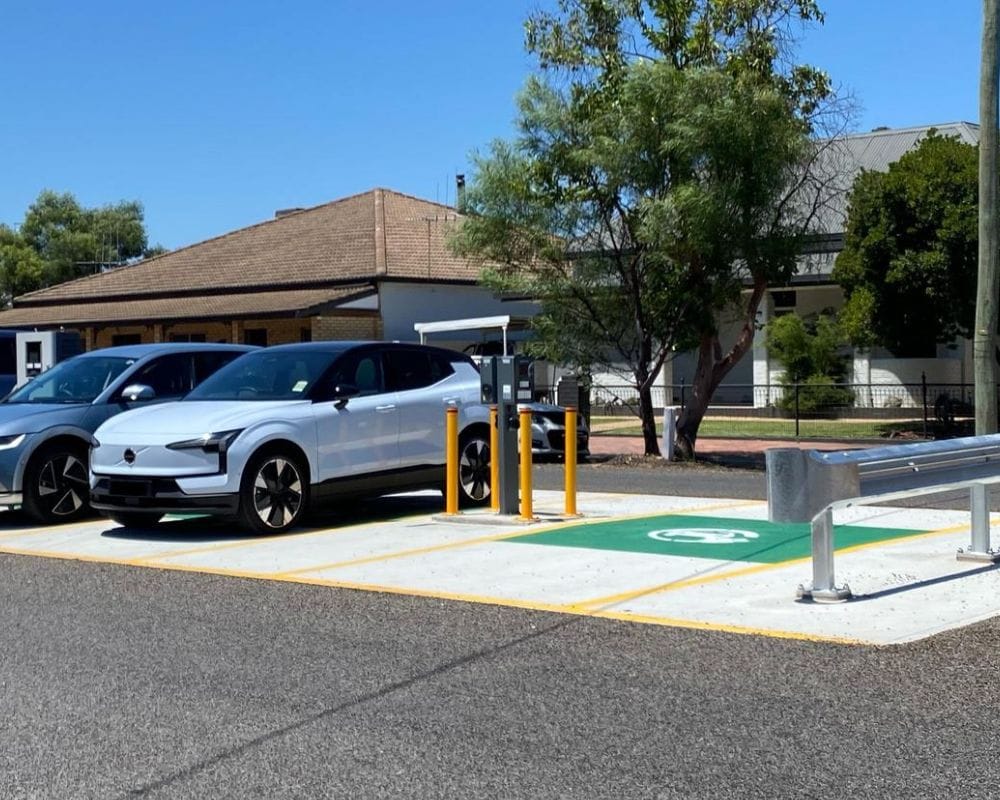
The Three Most Common Workplace EV Charging Scenarios
Scenario 1: Company or Novated Lease EV Charged at Work
This is the simplest scenario. When a business installs EV chargers at its premises and an employee charges a company-provided or novated lease EV during work hours, the employer covers the electricity cost as part of operating the vehicle.
The private use of an eligible electric car, and the cost of electricity to charge it, is exempt from FBT under the Electric Car Discount. This means there is no additional tax burden on the employer for providing free on-site charging to staff driving eligible EVs.
This is the most tax-efficient workplace charging setup for Australian businesses and the most common arrangement among employers who have already transitioned to EV fleets.
Scenario 2: Company or Novated Lease EV Charged at Home
Many employees with company EVs or novated leases charge their vehicles overnight at home. In this case, the employee pays for the electricity out of pocket, so the employer should be reimbursing them.
The ATO’s finalised PCG 2024/2 provides a standardised, low-friction reimbursement method without needing a smart charger or separate metering:
- Employer reimburses at the ATO flat rate of 4.20 cents per kilometre for home-charged kilometres
- Odometer readings at the start and end of the financial year are required
- No electricity bill reconciliation or charger data is needed
- Treated as an exempt expense-payment fringe benefit for novated leases
Important: You Cannot Mix Methods
If you use the ATO
home charging rate, you cannot also include
commercial charging station costs unless the vehicle can accurately determine the percentage of its total charge by location type. The two methods cannot be combined.
Scenario 3: Employee-Owned EV Charged at Work
When an employee drives their own personal EV and charges it at a workplace charger, the employer is effectively providing a benefit by covering the employee’s personal fuel costs.
Most Australian businesses handle this one of three ways:
- Free charging as a staff benefit: The employer absorbs the electricity cost as a perk. For most businesses, the cost is minimal.
- Fee-based charging: A smart charger with payment functionality charges employees at or near the residential electricity rate.
- No workplace charging policy: The business does not provide charging; employees arrange it elsewhere.
Note
There is no legal requirement in Australia for employers to provide EV charging to staff driving personal vehicles. However, as EV uptake accelerates, workplace charging is increasingly treated as an employee benefit comparable to parking allowances.
Tax Implications For Employers
FBT Exemption for Eligible EVs
Under the Electric Car Discount, eligible zero or low emissions vehicles, including fully electric cars under the Luxury Car Tax threshold of $91,387 in FY 2025–26, are exempt from Fringe Benefits Tax. Employers providing company EVs or covering charging costs for novated leases do not pay FBT on those benefits.
PHEV Change from 1 April 2025
Plug-in hybrid electric vehicles (PHEVs) are no longer considered zero or low emissions vehicles under FBT law from this date. The FBT exemption does not apply to new PHEV arrangements entered into from 1 April 2025.
Deductibility of Charger Installation Costs
The cost of purchasing and installing workplace EV chargers is generally tax deductible as a business expense. Businesses should speak with their accountant about whether an immediate deduction or depreciation schedule applies based on asset value and business structure.
Reportable Fringe Benefits Amount (RFBA)
Even where an EV is FBT-exempt, the benefit may still be reportable. If the taxable value exceeds $2,000, the employer must include the grossed-up amount in the employee’s RFBA. This can affect Medicare levy surcharge thresholds and certain government benefits, so communicate this clearly with affected staff.
Can An Employee Claim Ev Charging As A Work Expense?
If an employee uses their personal EV for work-related travel and charges at home, they may be able to claim a portion of electricity costs as a work-related car expense in their individual tax return.
For income tax purposes, employees enter the EV home charging claim at item D1 Work-related car expenses using claim type code ‘B’. The same ATO rate of 4.20 cents per kilometre applies.
Employees must keep records of work-related kilometres. A logbook or odometer records are the most reliable method. Electricity bills alone are not sufficient, as home charging cannot be separately metered from general household electricity in most EVs.
What Is The Best Approach For Your Business?
The right workplace charging arrangement depends on fleet size, your car policy, and whether employees drive company vehicles or personal EVs.
| Your Situation |
Recommended Approach |
| Company fleet EVs charged on-site |
Employer pays. FBT exempt for eligible EVs. |
| Novated lease EVs charged at home |
Employer reimburses at ATO rate of 4.20c/km |
| Personal EVs charged at work |
Free charging as a perk, or fee-based smart charger |
| Large workforce with mixed EV/non-EV drivers |
Fee-based smart charger system, fairer for all staff |
| Fleet transitioning to EVs |
Install smart chargers now. Load management is essential. |
Recommended For Workplace Installations
| Ocular IQ Wallbox |
Ideal for small-to-medium workplaces. Single or three-phase, supports
OCPP software integration for billing, access control and load management. |
| Ocular IQ Commercial |
Suitable for multi-bay workplace installations. Best for outdoors due to
its heavy duty metallic design for all climates. Supports OCPP software
integration for billing, access control and load management. |
| DC Fast Chargers |
For fleet depots or high-turnover commercial sites needing rapid turnaround.
Output ranges from 20kW up to 1MW depending on site requirements. |