Electrifying a bus depot is not the same problem as electrifying a car fleet. The vehicles are heavier, the batteries are larger, the charge windows are shorter, and the consequences of getting the infrastructure wrong are felt by everyone who relies on public transport to get to work in the morning.
A depot running diesel buses has a relatively simple energy profile. Fuel tanks get topped up. Buses leave. The electrical load on the site is whatever it takes to run the lights, the workshop, and the administration building.
An electric bus depot has a completely different energy profile. Every vehicle parked overnight is drawing power. The aggregate load can reach several megawatts. The distribution network may not have been designed to supply anything close to that level of demand at a single point. And the window during which buses need to be charged — typically between the last service return and the first departure — is fixed by the operational timetable, not by what the grid finds convenient.
EVSE’s work with CDC Victoria (ComfortDelGro Australia) and Monash University on electric bus depot infrastructure illustrates what this looks like in practice. This article draws on that experience to explain what large-scale bus depot electrification actually involves from an engineering standpoint — including the grid constraints that determine feasibility, the load management systems that make high charger densities viable, and the civil works that most project plans significantly underestimate.
The Depot Energy Problem: Why Bus Charging Is Different
Consider a depot returning 80 articulated electric buses overnight. Each bus might carry a 350kWh battery. If each bus needs 60 percent charge replenished overnight, that’s 210kWh per vehicle. Across 80 vehicles, that’s 16,800kWh of energy that needs to be delivered in roughly eight hours.
Delivering 16,800kWh in eight hours requires an average power draw of 2,100kW — 2.1 megawatts. That figure represents the average demand assuming perfectly smooth distribution across the entire window. In reality, without active load management, the demand profile is not smooth. Chargers that all start drawing at the same time create a demand spike that the distribution network may not be able to supply, and that will trigger very high demand charges even if it can.
| Example depot: 80 electric buses |
350kWh battery capacity each |
| Overnight charge requirement (60% SoC) |
~210kWh per vehicle |
| Total overnight energy required |
~16,800kWh |
| Charge window (typical) |
8–10 hours |
| Unmanaged peak demand (worst case) |
3.5 — 5MW |
| Managed peak demand (with ALM) |
1.8 — 2.5MW |
The gap between unmanaged and managed peak demand in that example — 2 to 3 megawatts — is the difference between needing a dedicated high-voltage substation and potentially being able to work with an upgraded distribution network connection. In dollar terms, that gap can be worth $1 to $3 million in avoided infrastructure cost.
Active Load Management at Megawatt Scale
Active load management at depot scale is architecturally different from the load management systems used in smaller commercial installations. The stakes are higher, the variables are more complex, and the consequences of a system failure affect an entire fleet’s departure schedule.
The Core Architecture
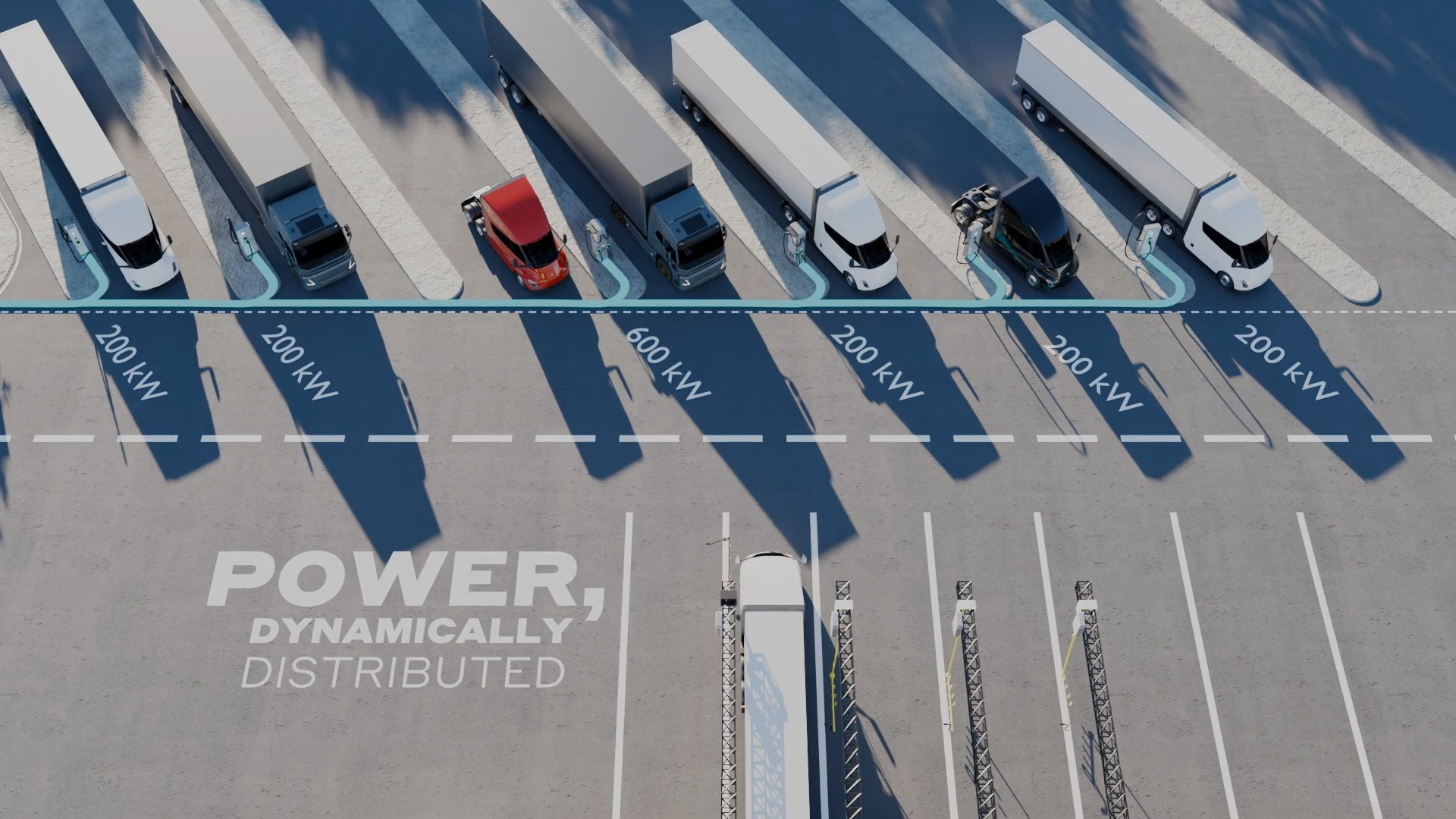
A depot-scale ALM system sits between the site’s energy management infrastructure and the individual chargers. It monitors the site’s total available electrical capacity — the ceiling set by the incoming supply and the DNSP connection — in real time. It also monitors the current state of charge of each connected vehicle, the scheduled departure time of each bus, and the current building load from non-charging sources.
Using this data, the system calculates an optimal charging schedule that meets every vehicle’s departure requirement while keeping the total site demand within the defined ceiling. It distributes that schedule across the charger network via OCPP (Open Charge Point Protocol), which allows it to send real-time charging commands to individual units.
When conditions change — a bus is disconnected mid-charge, the building load spikes due to workshop activity, or a charger fault removes capacity from the pool — the system recalculates and redistributes in real time. Human intervention is only required if the aggregate demand ceiling and the fleet’s departure requirements are genuinely incompatible, which proper capacity planning should prevent.
OCPP and Interoperability
OCPP compliance is not optional for depot-scale installations. It’s the protocol that makes multi-vendor interoperability possible, allows the ALM system to communicate with chargers regardless of brand, and ensures the installation is not locked to a single hardware supplier for the life of the depot.
OCPP 1.6 is the current widely-deployed standard in Australia. OCPP 2.0.1 introduces more sophisticated smart charging capabilities and is increasingly specified in new large-scale projects. For bus depots, where the charger network may include equipment from multiple suppliers and where the ALM software needs granular control over individual charge sessions, OCPP 2.0.1 compliance is worth specifying from the start.
Design principle: Specify OCPP 2.0.1 compliance in the charger procurement brief before selecting hardware. Retrofitting protocol compatibility after installation is significantly more expensive than specifying it upfront.
Priority Charging and Departure Sequencing
One of the more operationally valuable features of a well-implemented ALM system is departure-based priority charging. The system takes the next day’s operational schedule — which buses need to depart first, which routes have highest energy requirements — and weights charging priority accordingly.
Buses leaving at 4:30am for first services get full charge allocation from the moment they’re connected. Buses on later services get scheduled to charge during off-peak periods, including periods when the overall site demand is lower and more capacity is available. Vehicles that aren’t leaving until mid-morning might not begin meaningful charging until after midnight.
The operational result is that every bus meets its departure requirement, the grid demand profile is flattened, and the depot’s peak demand charges are minimised — all without requiring depot operations staff to actively manage the charging schedule.
High-Voltage Civil Works: The Component That Surprises Most Project Teams
Civil works are consistently the component that project teams underestimate, both in cost and in the effect on project timelines. This is partly because civil works are less visible than charger hardware — they mostly happen underground — and partly because their scope isn’t fully known until detailed site investigation has been completed.
What HV Civil Works Typically Covers
For a bus depot drawing megawatt-scale power, high-voltage civil works encompasses several interconnected elements.
- HV cable trenching and installation from the network connection point to the on-site transformer or switchroom
- Construction of the transformer pad and any associated civil protection structures
- Installation of the HV switchgear and protection equipment
- Switchroom construction or modification to house the HV equipment safely
- Cable duct and pit installation for the distribution of power from the switchroom to charger positions across the depot
- Earthing and bonding works throughout the installation
- Civils associated with charger mounting — bases, conduit, weather protection
Each of these elements interacts with the physical condition of the site. An older depot may have decades of underground services — drainage, gas, telecoms, previous electrical installations — that complicate cable routing. Concrete hardstand areas require saw-cutting and reinstatement. Structures may need modification to accommodate cable entry points.
A detailed site investigation — including ground-penetrating radar to locate existing underground services — is essential before civil costs can be reliably estimated. Projects that proceed to tender on civil works without this investigation routinely encounter variation claims during construction.
Lead Times and Construction Sequencing
High-voltage switchgear and transformers are not off-the-shelf items. Lead times for HV equipment from major suppliers have extended significantly in recent years, running to twelve months or more for some equipment types. Projects that don’t order early find that everything else is ready — chargers installed, software configured, vehicles purchased — and the project is still waiting for a transformer.
The construction sequencing for HV civil works also requires careful coordination. Trenching work can’t begin until underground service locations are confirmed. The transformer can’t be installed until the civil pad is complete. HV switchgear installation requires specific hold points for inspection. And the DNSP won’t energise the connection until their own inspection requirements are satisfied.
For a project with a fixed operational start date — a transit authority taking delivery of electric buses that need to be operational by a certain date — the HV civil works timeline is often the critical path. It needs to be planned backwards from the energisation date, not forwards from a project start date.
Timeline reality check: From decision to energised connection for a megawatt-scale bus depot, allowing for DNSP approval, equipment procurement, civil works, and commissioning, a realistic timeline is twelve to twenty months. Projects that assume six months consistently run late.
The CDC Victoria / Monash University Project
EVSE’s involvement in the CDC Victoria electric bus depot project with Monash University provided a direct demonstration of these engineering principles applied to a real operational environment. The project involved electrifying bus depot operations to support CDC’s transition away from diesel, with Monash providing independent research oversight of the technical outcomes.
The key engineering challenges were consistent with those described above: determining the available grid capacity at the depot location, designing an ALM system capable of managing overnight fleet charging within that capacity envelope, and specifying the civil and electrical infrastructure to support the charger density required.
The project also highlighted an operational consideration that is often underweighted in technical planning: the interface between the charging infrastructure and the depot’s existing management systems. Bus depots run on operational schedules. The charging infrastructure needs to receive that schedule data and act on it, which requires integration between the charger management system and the depot’s rostering and dispatch software. This integration is not complex, but it needs to be specified, designed, and tested — and it’s frequently left to the commissioning phase, by which point time pressure creates risk.
What Depot Operators Should Demand from Their Infrastructure Partner
The engineering complexity of bus depot electrification creates real differentiation between infrastructure partners. Not all providers have designed and built at megawatt scale. Not all have managed DNSP engagement for HV connections. Not all have commissioned ALM systems that interface with operational scheduling software.
The questions worth asking when evaluating providers include the following.
- How many megawatt-scale depot installations have you delivered in Australia? Can we speak with the operators?
- How do you manage DNSP engagement — do you handle it directly, or does the client?
- What ALM software platform do you use, and does it support OCPP 2.0.1?
- How do you handle the interface between charging management and our operational scheduling systems?
- Who manages the HV civil works — directly, or through a subcontractor? What is your quality assurance process?
- What is your response time commitment for fault resolution, and what happens to the charging schedule if a charger goes offline?
An infrastructure partner who can answer these questions in detail, with reference to completed projects, is meaningfully different from one who treats depot electrification as a scaled-up version of a commercial carpark installation. The difference shows up in the commissioning phase, and it shows up in the first operational winter when the depot is drawing maximum load and the ALM system needs to perform exactly as designed.
Bus depot electrification in Australia is moving from pilot to mainstream faster than most transit authorities anticipated. The engineering frameworks described in this article — grid feasibility, substation integration, active load management, HV civil works — are not edge cases for unusual projects. They are the standard requirements for any serious electric bus depot deployment. Understanding them is the first step to planning one that works.
-
Job Title - Co-Founder, EVSE Australia
11 years of EV charging deployment history
EV specialist, ev driver, member of AFMA, AEVA, EV Council, HVIA
Sam Korkees is the Co-Founder of EVSE Australia, a leading provider of electric vehicle (EV) charging infrastructure and solutions. Since co-founding the company in 2014 alongside Brendan Wheeler, Sam has played a pivotal role in scaling EVSE from an early-stage startup into a nationally recognised leader in EV charging.
EVSE has delivered some of the country's largest EV fleet and depot charging deployments, supporting the electrification of commercial fleets, logistics operations, and government assets. The company is also recognised as a leader in public charging infrastructure, with extensive experience in the rollout of fast and ultra-fast DC charging networks nationwide.
Sam works closely with government, utilities, and enterprise clients to design and implement scalable, future-ready charging solutions, helping accelerate the adoption of EVs across Australia.
Credentials: 11 years of EV charging deployment history, EV specialist, EV driver, member of AFMA, AEVA, EV Council, HVIA