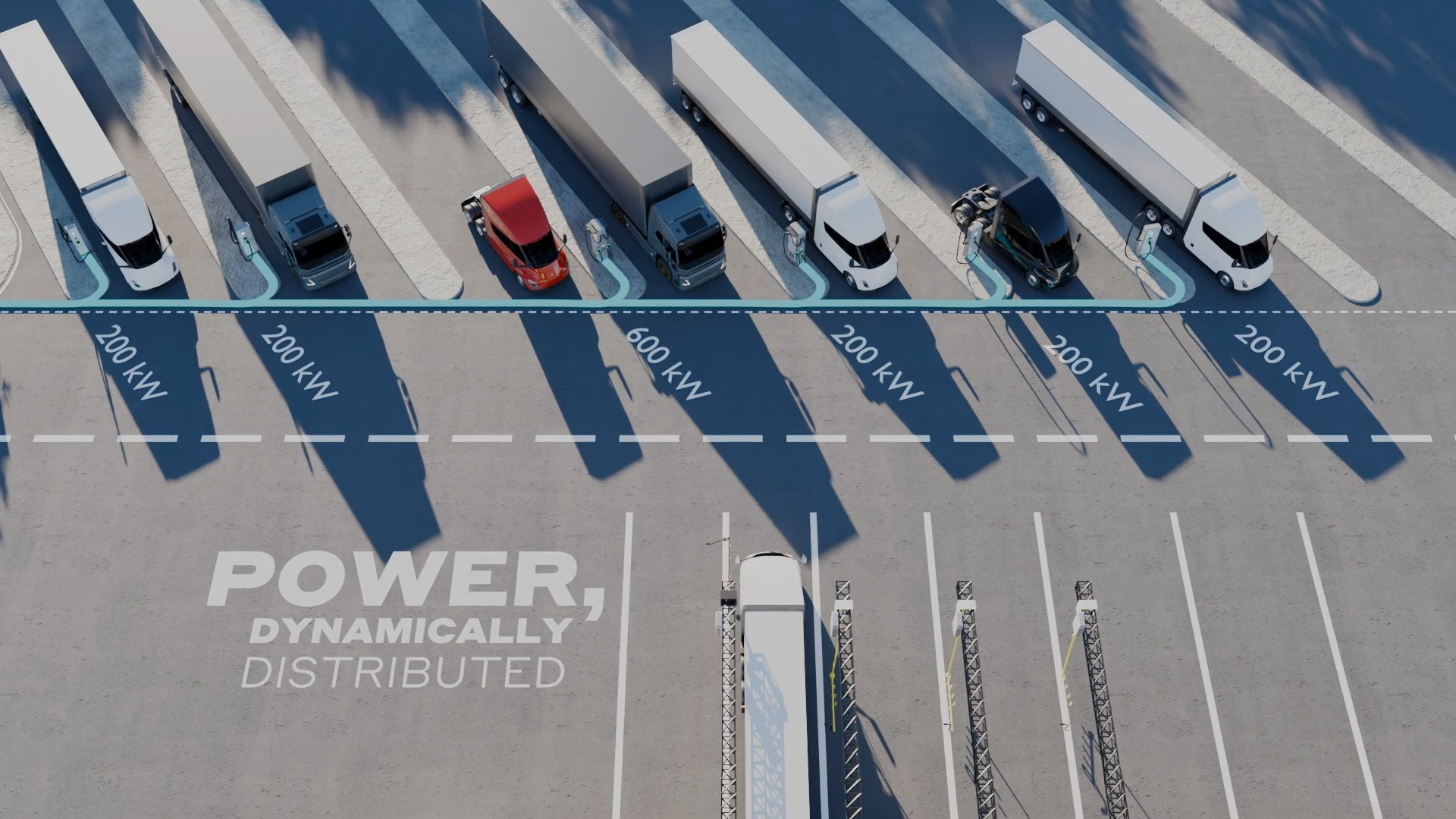
The commercial EV conversation in Australia spent its first decade focused almost entirely on passenger cars and light vans. The infrastructure assumptions built around that conversation — overnight AC charging, 7kW to 22kW wall units, switchboard upgrades in the tens of thousands of dollars — don’t transfer to heavy transport. A prime mover pulling 60 tonnes across interstate routes carries a fundamentally different energy requirement. Its battery is measured in hundreds of kilowatt-hours, not dozens. Its operational schedule is dictated by freight contracts and driver hours legislation, not the convenience of a home garage.
The charging standard that addresses this is Megawatt Charging System (MCS). Developed by CharIN, the same organisation that produced the CCS standard now ubiquitous in passenger and light commercial EVs, MCS is purpose-built for heavy-duty battery electric vehicles where CCS falls short. This article covers what MCS is, what it demands of depot infrastructure, and what Australian fleet operators planning heavy vehicle electrification need to understand before committing to any design.
What MCS Is and Why CCS Doesn’t Scale to Heavy Haulage
The Combined Charging System (CCS), in its current Australian deployment, typically delivers between 50kW and 400kW of DC power. For a passenger EV with a 75kWh battery, 150kW charges the vehicle in 30 minutes. For a prime mover with a 600kWh to 1,000kWh battery, the same 150kW charger takes three to five hours — an operational impossibility on a tight freight schedule.
MCS resolves this by operating at an entirely different power scale. The standard, formalised through IEC 63379 (released February 2026) and SAE J3271 (published March 2025), supports charging at up to 3.75 megawatts — 3,000 amps at 1,250 volts DC. At that power level, a 1,000kWh battery can be recharged from 20 to 80 percent in under 30 minutes. That’s a window that fits naturally into a driver’s mandatory 45-minute rest break under Australian heavy vehicle legislation, which requires rest after five and a half hours of driving.
The practical consequence is significant. A prime mover capable of accepting MCS charging can operate on long-haul interstate routes without scheduling deviations for charging stops, in the same way a diesel truck currently uses mandatory rest breaks for refuelling. The charging happens during time that’s already lost to regulation. This is the design intent of the standard, and it’s why MCS is increasingly described as the technology that makes long-haul electric freight commercially viable rather than merely technically possible.
| Specification |
Detail |
| MCS maximum power rating |
3.75MW (3,000A at 1,250V DC) |
| IEC standard (connector) |
IEC 63379 — released February 2026 |
| SAE standard (system) |
SAE J3271 — published March 2025 |
| Charge time: 1,000kWh battery (20-80%) |
Under 30 minutes at 1MW+ |
| CCS2 comparison (350kW) |
Same charge takes approx. 2.5 hours |
| Communication protocol |
ISO 15118-20 (Automotive Ethernet 10BASE-T1S) |
| Connector cooling |
Liquid-cooled cable mandatory |
MCS in the Australian Heavy Transport Context
Australia’s heavy transport sector has characteristics that make MCS both more challenging and more necessary than its European counterpart. European MCS deployment has been concentrated on motorway corridors — fixed routes between logistics hubs where charging infrastructure can be installed at predictable intervals. Australian freight routes are longer, less predictable, and often pass through regional areas where grid infrastructure is limited.
The immediate opportunity for MCS in Australia is not on-route corridor charging but depot-based charging. Toll Group’s Project TruckVolt — the $67 million investment in battery electric heavy vehicles across 10 distribution centres nationally — represents the current frontier of large-scale depot charging in the country. The infrastructure deployed at TruckVolt sites uses high-power DC charging, and as MCS-capable vehicles enter the Australian market from OEMs including Volvo and Daimler Truck, the infrastructure question shifts to whether depots are designed to accept megawatt-scale power delivery.
The vehicle side is coming. Scania has confirmed MCS-capable BEVs from mid-2026. Volvo, Daimler Truck, and Traton are all at various stages of MCS vehicle rollout. The world’s first public MCS charging session took place in August 2025, at Alfredsson Transport’s site in Sweden. The technology is not speculative. For Australian depot operators who are making infrastructure decisions today, the question is whether to design for MCS now or retrofit later — and the answer depends heavily on the total cost of each path.
What MCS Infrastructure Actually Requires
Deploying MCS at a depot is a materially different exercise from deploying high-power CCS. The technical requirements cascade from the connector specification through the charging hardware, the site electrical infrastructure, and the grid connection.
The MCS Connector and Cable
The MCS connector is a seven-pin design, distinct from the CCS2 connector currently standard in Australia. It includes an automated locking mechanism, which is necessary because the forces involved in a 3,000-amp connection require positive mechanical engagement. The cable is liquid-cooled — mandatory under the standard — because passive cooling cannot dissipate the thermal load generated at megawatt power levels.
For depot operators, this means the charging hardware itself is more expensive and more complex than CCS equivalents. MCS units require integrated cooling loops, higher-rated electrical connections, and more sophisticated power electronics. ABB has announced 1,200kW MCS-capable units for 2025 deployment. Kempower delivered its first MCS systems in late 2024 and has commercial installations operating in Scandinavia. These are the hardware choices that will define the Australian market.
Site Electrical Infrastructure
A single MCS charger delivering 1MW requires a dedicated high-current feed from the site’s main electrical infrastructure. At 1,000 amps, the cable sizing, protection equipment, and switchgear specifications are substantially different from anything in a standard commercial installation.
A depot with four MCS chargers simultaneously delivering 1MW each creates a 4MW demand on the site’s incoming supply. This is beyond the capability of a standard low-voltage network connection for most Australian sites. It typically requires a dedicated substation — a high-voltage connection stepped down on-site through a purpose-built transformer and switchroom.
The civil works for this level of infrastructure include high-voltage trenching from the network connection point, concrete transformer pads, high-voltage switchgear enclosures, and the distribution infrastructure to deliver power from the substation to individual charger positions across the depot. These are not minor additions to an existing site. They are a significant construction project in their own right.
Grid Connection and DNSP Engagement
A 4MW depot-scale MCS installation represents the kind of load that most Australian distribution network service providers (DNSPs) will flag for formal technical review. The connection application process can take six to eighteen months. For MCS-scale loads, the timeline and cost of DNSP engagement is a first-order project planning input, not an afterthought.
The practical implication is that MCS depot infrastructure needs to be planned twelve to twenty-four months before the first MCS-capable vehicle arrives. Organisations that start the infrastructure process when the vehicles are ordered will almost certainly find themselves with vehicles they can’t charge.
Design insight: Several European logistics operators deploying MCS infrastructure have installed battery energy storage systems (BESS) alongside their MCS chargers. The BESS charges from the grid at off-peak rates and delivers peak power to the MCS chargers during charging sessions, reducing the peak grid demand and allowing the DNSP connection to be sized for average rather than peak load. This can meaningfully reduce infrastructure costs for sites where DNSP augmentation would otherwise be required.
Depot Design for MCS: Key Considerations
Charger Positioning and Truck Movement
MCS charging positions require more physical space than standard CCS positions. The liquid-cooled cables are heavier and less flexible than standard charging cables, which affects the range of motion available and the approach angle required for a prime mover to connect. Depot designs that work perfectly for CCS may need to be modified to accommodate MCS geometry.
The automated locking connector adds a step to the connection process that drivers need to be trained on. Unlike CCS, where a driver plugs in a connector manually, MCS requires the locking mechanism to engage correctly before charging can commence. This is a minor operational consideration but one that affects the design of driver training programs and the positioning of the charger relative to the cab.
Mixed Fleet Charging Strategies
Most heavy transport depots operate mixed fleets — prime movers alongside rigid trucks, light commercials, forklifts, and other equipment. These vehicles have different charging requirements. A depot design that works for prime mover MCS charging needs to accommodate the coexistence of CCS2 charging for lighter vehicles and potentially AC charging for electric forklifts and yard equipment.
The active load management system that governs MCS charging needs to be able to coordinate across all charger types, prioritising load allocation based on vehicle departure schedules and state of charge across the full fleet. This is a more complex orchestration problem than a single-vehicle-class depot, and the software platform selected for the depot needs to handle it.
Future-Proofing for Higher Power Levels
The MCS standard supports up to 3.75MW, but current commercially available hardware is delivering in the 1MW to 1.2MW range. The standard is designed to scale, and the infrastructure decisions made today should account for the likelihood that future MCS hardware will operate at higher power levels than current units.
This means designing the electrical infrastructure with headroom. Switchgear rated for higher current than today’s loads, cable routes sized for additional circuits, and substation transformers specified for the depot’s five to ten-year load rather than its day-one requirement. The incremental cost of building in this headroom is small relative to the cost of a full infrastructure replacement in five years.
CCS2 vs MCS: The Decision Framework for Australian Heavy Fleet Operators
For many Australian operators, the right answer for the immediate term is not MCS — it’s high-power CCS2 designed and installed with MCS upgrade capability. Here’s why.
MCS-capable heavy vehicles are entering the Australian market from 2026, but fleet penetration will be gradual. The economics of MCS infrastructure — which requires substation investment at the scale of most large depots — only make sense when the charger utilisation justifies the capital. A depot with five MCS-capable vehicles doesn’t generate enough charging revenue or OPEX savings to justify the full MCS infrastructure build.
The transitional strategy that makes most sense for the majority of Australian heavy vehicle operators right now is high-power CCS2 (350kW to 400kW) with a site electrical infrastructure designed for MCS-scale future load. This means investing in the substation, the HV civil works, and the load management software now — elements that don’t need to be replaced when MCS vehicles arrive — while deferring the MCS charger hardware until the fleet population justifies it.
| Decision Factor |
Recommended Approach |
| Now (CCS2 depot) |
350-400kW DC per position, OCPP 2.0.1, ALM platform |
| MCS-ready infrastructure now |
Substation, HV civil works, cable routes, BESS provisions |
| MCS hardware timing |
When 10+ MCS-capable vehicles are operational at the depot |
| Key standard to specify |
OCPP 2.0.1 for both CCS2 and future MCS management |
| First MCS OEM vehicles (AU) |
Scania, Volvo, Daimler — from mid-2026 |
This approach avoids the mistake of either under-investing (CCS2 hardware on infrastructure that can’t scale) or over-investing (MCS hardware deployed years before the vehicles that need it arrive). The infrastructure is the long-lived, expensive component. The charger hardware is the fast-moving component. Sequencing the investment accordingly is the decision that holds up best across the range of possible futures.
Megawatt Charging System is not a technology that Australian heavy vehicle operators can afford to treat as a distant future concern. The vehicles are arriving. The standard is finalised. The operators that are designing their depot infrastructure now — without accounting for MCS — are designing infrastructure that will need to be rebuilt in five years. The cost of building for it now is less than the cost of retrofitting later, and the technical decisions required to do so are available and well understood.
Frequently Asked Questions
What is a Megawatt Charging System (MCS) and how does it differ from CCS2?
MCS is a heavy-duty EV charging standard developed by CharIN that supports up to 3.75MW — significantly more than the 50kW to 400kW range of CCS2. MCS uses a seven-pin liquid-cooled connector and is purpose-built for prime movers and heavy haulage vehicles with large battery packs (600kWh to 1,000kWh+). CCS2 is suitable for passenger vehicles and light commercial vehicles but cannot deliver charge fast enough to meet operational requirements for heavy freight.
Is MCS charging available in Australia now?
MCS-capable vehicles are beginning to enter the Australian market from mid-2026, with Scania, Volvo, and Daimler Truck leading the rollout. The first public MCS charging session globally took place in August 2025. Infrastructure and hardware are commercially available, but widespread Australian deployment is in early stages. Depot operators making infrastructure decisions now should design for MCS readiness even if the hardware isn’t installed immediately.
How long does it take to charge a heavy truck using MCS?
At 1MW+ power delivery, a 1,000kWh battery can be recharged from 20 to 80 percent in under 30 minutes. This is specifically designed to align with mandatory driver rest breaks under Australian heavy vehicle legislation, which requires a 45-minute break after five and a half hours of driving — meaning charging can happen during time that’s already legislatively required.
What electrical infrastructure does an MCS depot require?
A single MCS charger delivering 1MW requires a dedicated high-current electrical feed. A depot running four simultaneous 1MW chargers requires 4MW of site capacity, which typically needs a dedicated high-voltage substation with purpose-built transformer and switchroom. The civil works — HV trenching, transformer pads, switchgear enclosures, distribution infrastructure — are a significant construction project. DNSP engagement for a load of this scale can take six to eighteen months.
Should Australian fleet operators invest in MCS infrastructure now or wait?
The recommended approach for most operators is to invest in MCS-ready site electrical infrastructure now (substation, HV civil works, cable routes, BESS provisions) while deploying high-power CCS2 charger hardware in the interim. This separates the long-lived infrastructure decision from the fast-moving hardware decision. MCS charger hardware should be deployed when 10 or more MCS-capable vehicles are operational at the depot.
What is OCPP and why does it matter for MCS depot management?
Open Charge Point Protocol (OCPP) is the communication standard that allows charger hardware from multiple manufacturers to be managed through a single software platform. OCPP 2.0.1 is the current specification and is recommended for any MCS or CCS2 depot installation. It provides smart charging controls, end-to-end encryption, enhanced session data, and V2G (vehicle-to-grid) functionality. Specifying OCPP 2.0.1 from procurement preserves operational flexibility over the infrastructure’s lifetime.
How does battery energy storage (BESS) help with MCS depot charging?
A BESS installed alongside MCS chargers charges from the grid at off-peak rates and delivers peak power during charging sessions. This reduces peak grid demand, which can allow the DNSP connection to be sized for average rather than peak load — meaningfully reducing infrastructure costs for sites that would otherwise require expensive DNSP network augmentation. It also provides resilience if the grid connection has capacity constraints.
-
Job Title - Co-Founder, EVSE Australia
11 years of EV charging deployment history
EV specialist, ev driver, member of AFMA, AEVA, EV Council, HVIA
Sam Korkees is the Co-Founder of EVSE Australia, a leading provider of electric vehicle (EV) charging infrastructure and solutions. Since co-founding the company in 2014 alongside Brendan Wheeler, Sam has played a pivotal role in scaling EVSE from an early-stage startup into a nationally recognised leader in EV charging.
EVSE has delivered some of the country's largest EV fleet and depot charging deployments, supporting the electrification of commercial fleets, logistics operations, and government assets. The company is also recognised as a leader in public charging infrastructure, with extensive experience in the rollout of fast and ultra-fast DC charging networks nationwide.
Sam works closely with government, utilities, and enterprise clients to design and implement scalable, future-ready charging solutions, helping accelerate the adoption of EVs across Australia.
Credentials: 11 years of EV charging deployment history, EV specialist, EV driver, member of AFMA, AEVA, EV Council, HVIA