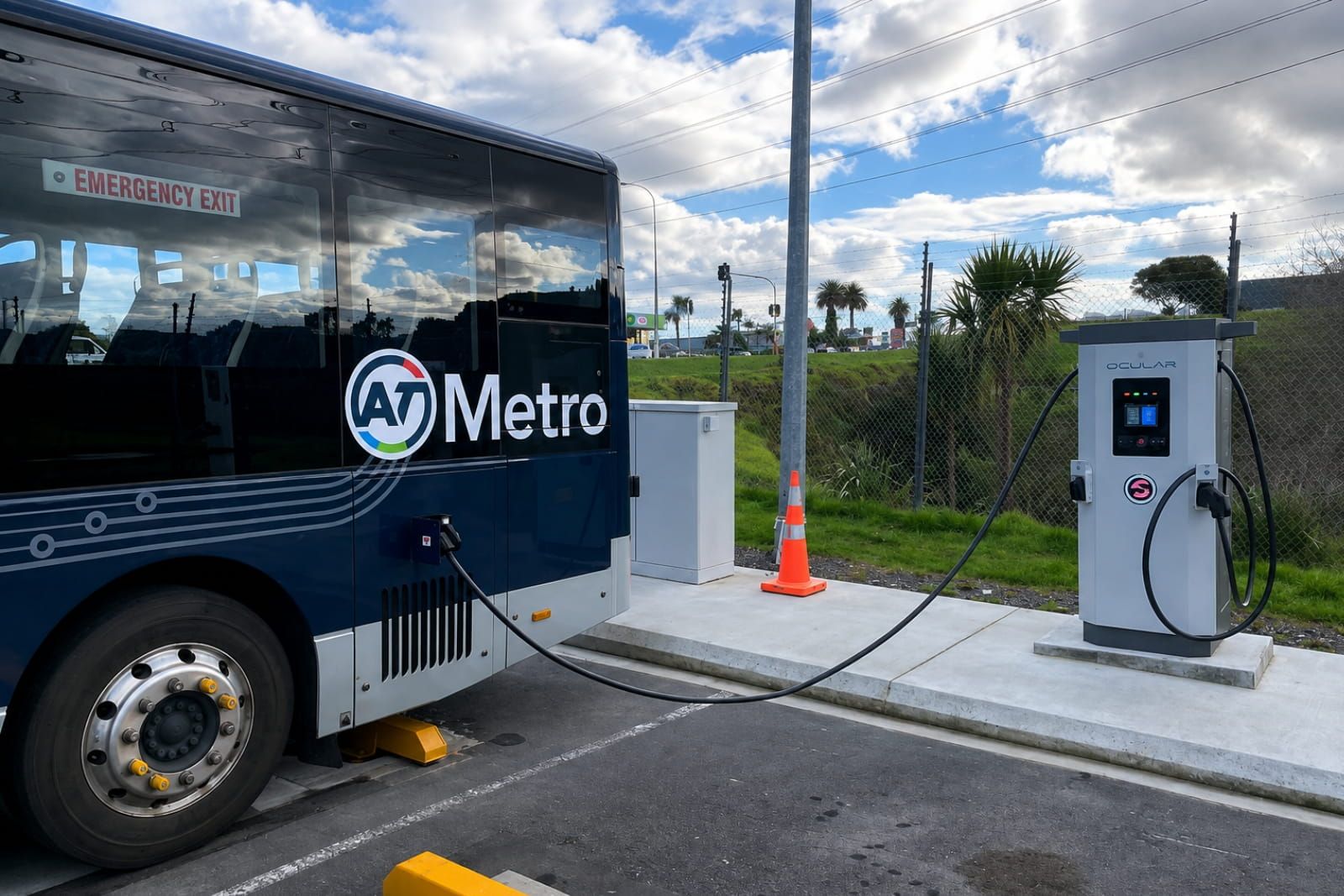
The decision to electrify a public transport bus fleet is not primarily a procurement decision.
It looks like one from the outside, which vehicles, which OEM, which contract structure. But the decisions that determine whether the fleet actually operates reliably are infrastructure decisions: how the depot is connected to the electricity network, how charging is orchestrated across dozens of buses simultaneously, and whether the grid can deliver the power required within the overnight window the timetable allows.
Transit authorities that have treated electrification as a vehicle procurement problem have consistently encountered operational problems at the infrastructure stage. Vehicles arrive before the depot can charge them. Grid connections take longer than expected. Load management software isn’t configured for the actual departure schedule. The result is a fleet sitting on a depot apron with insufficient charge to operate the morning run.
This article draws on EVSE’s work with ComfortDelGro Australia (CDC Victoria) and Monash University’s independent research oversight to set out a practical planning framework for electric bus depot infrastructure, covering grid feasibility, overnight charging strategy, active load management, and the civil works that most project timelines underestimate.
Starting with the Right Question
The question transit authorities typically ask first is: how many chargers do we need? The question they should ask first is: what can our depot’s grid connection actually support, and how does that constrain everything else?
A bus depot’s electrical infrastructure was designed around the loads of a diesel operation, workshop equipment, lighting, administration, potentially a fuel pump. The electrical demand of charging 60 or 80 buses overnight bears no relationship to any of that. Before charger selection, before software selection, before any procurement decision, a grid feasibility assessment is required that answers three specific questions: what is the current incoming supply capacity at the depot, what does the distribution network operator (DNSP) have available at the network connection point, and what is the gap between what’s needed and what’s there?
The gap is almost always significant. For a depot charging 80 standard electric buses with 300kWh batteries at 60% average overnight replenishment, the energy required in an eight-hour window is around 14,400kWh. Delivering that requires an average continuous power of approximately 1.8MW. Unmanaged, all chargers drawing simultaneously, the peak demand could reach 3.5 to 5MW. Most depot distribution network connections are not sized for either figure.
Example: 80-bus electric depot
| Battery capacity per bus |
300kWh (typical standard bus) |
| Overnight energy required (60% SoC replenishment) |
~14,400kWh |
| Charging window |
8 to 10 hours (last return to first departure) |
| Unmanaged peak demand |
3.5 to 5MW |
| Managed peak demand (with ALM) |
1.6 to 2.2MW |
| Infrastructure saving from ALM |
Potentially $1M+ in avoided substation cost |
Grid Upgrade Pathways: What the Options Actually Are
Upgrading the Network Connection
Where the existing network connection is under 500kW, a simple upgrade, larger incoming cable, upgraded metering, expanded switchgear, may be sufficient for small to medium bus fleets. The DNSP assesses the available capacity at the relevant network connection point and approves or conditions the upgrade. Timeline: four to twelve months, cost from $30,000 to $200,000 depending on the extent of works.
For larger depots or those in areas with constrained distribution network capacity, a network augmentation may be required, work on the DNSP’s own infrastructure to increase the capacity available at the connection point. This is funded by the organisation requesting the connection (through a capital contributions framework), takes longer to design and construct, and adds significant cost. Budget twelve to twenty-four months and costs from $200,000 to over $1 million depending on the scope of augmentation required.
Dedicated Substation
For depot-scale deployments requiring more than approximately 2MW, a dedicated high-voltage substation is typically the most cost-effective long-term solution. The substation takes a high-voltage supply directly from the transmission or distribution network and steps it down on-site, providing a large and reliable source of power independent of the street-level low-voltage network.
The capital cost of a dedicated substation, typically $500,000 to $2 million depending on capacity and civil conditions, is substantial. But for a depot that will operate for twenty or more years and expand its electric fleet incrementally, the economics over that horizon are usually superior to upgrading a low-voltage connection in stages. The substation also provides future capacity for MCS-scale charging as the technology and vehicle types evolve.
Battery Energy Storage Integration
A growing number of transit authority projects are integrating battery energy storage systems (BESS) alongside depot charging infrastructure. The BESS charges from the grid at off-peak rates, typically between midnight and 6am, and supplements the grid supply during peak demand periods. This allows a larger number of buses to charge simultaneously than the grid connection alone could support, without requiring a larger or more expensive network connection.
For depots where DNSP augmentation would otherwise be required, a correctly sized BESS can eliminate that need entirely, saving the augmentation cost and timeline. The BESS itself becomes the capital investment, but it also provides demand charge management benefits that reduce the ongoing electricity bill, often generating a return on the BESS investment within three to five years through energy cost savings alone.
Planning principle: The grid upgrade pathway, network upgrade, dedicated substation, or BESS, is the first infrastructure decision, not a detail to be resolved later in the project. It determines the project timeline, the project budget, and the operational constraints on the charging strategy. Get this decision right first and everything downstream becomes cleaner.
Overnight Charging Strategy: Making the Window Work
Public transport bus fleets operate within a defined operational envelope. Buses return from evening service at staggered times between roughly 10pm and 1am. First departures for morning service begin at 4am to 4:30am. The available charging window is therefore five to seven hours for some buses, and eight to ten hours for others, depending on when they return and when they depart.
A naive charging strategy, plug in on arrival, charge at full speed until fully charged, creates two problems. First, it creates a demand spike as buses return in batches and all begin drawing at maximum rate. Second, it fails to distinguish between buses that need to be fully charged by 4:30am and buses that don’t leave until the 7am shift, wasting the opportunity to use the longer-dwell buses to smooth demand across the window.
An effective overnight charging strategy treats the available window as a resource to be allocated, not a fixed input. It takes the following day’s departure schedule and works backwards: which buses need to depart first, what state of charge do they need to achieve, and what charge rate over what window achieves that target while minimising peak demand.
Priority Sequencing in Practice
The practical implementation involves three tiers. First-departure buses, those leaving before 5am, are given immediate priority from the moment they connect. They charge at the maximum rate available to them, regardless of what other buses are doing. Second-tier buses, those departing in the 5am to 7am window, are allocated capacity as first-tier buses complete their charge cycles and free up capacity. Third-tier buses, those on later shifts or reserve schedules, charge last, using the remaining window.
This sequencing is managed by the active load management system, not by depot staff. The system receives the departure schedule from the depot management system each evening and translates it into charging priorities. Staff interaction is required only when the schedule changes unexpectedly, a bus taken out of service for maintenance, an emergency departure scheduled, a charger fault that reduces available capacity.
Energy Window Optimisation and TOU Tariffs
Most commercial electricity tariffs include time-of-use components where energy drawn after midnight and before 6am is significantly cheaper than energy drawn in the peak evening period. For a bus depot, this means there is a direct financial incentive to defer charging to the off-peak window where the operational schedule permits.
The load management system can incorporate tariff data to shift non-urgent charging into the cheapest available window. For a large depot, the annual saving from tariff-optimised scheduling can be $50,000 to $150,000 compared to unmanaged charging at the time of vehicle connection. Over a ten-year operational period, this saving materially improves the financial case for the infrastructure investment.
Active Load Management: The Technical Architecture
What ALM Does at Depot Scale
Active load management software sits between the depot’s energy management infrastructure and the individual charger units. Its core function is to monitor the site’s total available electrical capacity in real time and allocate that capacity across the connected charger pool dynamically, adjusting individual charger output rates to keep the aggregate site demand within the defined ceiling.
For a bus depot, the ceiling is set by the incoming electrical supply, either the DNSP connection capacity or the BESS output rate, whichever is the binding constraint at any given moment. The ALM system ensures that the total draw across all chargers never exceeds this ceiling, while simultaneously ensuring that every bus achieves its required state of charge before its scheduled departure.
OCPP as the Communication Foundation
OCPP (Open Charge Point Protocol) is the standard that enables the ALM system to communicate with individual chargers regardless of their manufacturer. OCPP-compliant chargers receive charging commands, start, stop, set charge rate, from the central management system and report status data back continuously.
For transit authority deployments, OCPP 2.0.1 compliance is worth specifying over the older OCPP 1.6 standard. OCPP 2.0.1 provides more granular smart charging controls, improved security, and better support for the kind of departure-based priority scheduling that public transport operations require. The difference in hardware cost is marginal; the difference in operational flexibility over a ten to fifteen-year infrastructure life is significant.
Integration with Fleet Management Systems
The charging strategy is only as good as the data feeding into it. A load management system that operates in isolation from the depot’s operational scheduling system will inevitably be misconfigured relative to actual departure requirements. The integration between the two systems, so that schedule changes propagate automatically into charging priorities, is what transforms ALM from a smart power meter into an operational tool.
For CDC Victoria’s electric bus depot project, the integration between the EVSE charging management platform and the depot’s operational systems was a critical design element. Schedule data flows into the charging platform continuously; charging priorities update dynamically as the schedule changes. The result is a system that responds to the actual operational reality of the depot, not a static configuration that becomes incorrect the moment anything changes.
Civil Works: The Timeline-Critical Component
Every large-scale bus depot electrification project that has run significantly over time has encountered the same problem: civil works took longer than planned. The electrical infrastructure required for depot-scale charging, cable trenching across the depot floor, transformer pad construction, switchroom installation, charger base preparation across potentially dozens of positions, is a substantial construction project that interacts with a working depot in ways that are difficult to fully predict from a desktop plan.
The Key Civil Works Elements
- HV cable trenching from network connection point to on-site transformer or switchroom
- Concrete transformer pad and protection enclosure construction
- Installation of HV switchgear, protection relays, and metering equipment
- Main switchroom modifications or new switchroom construction
- LV distribution cabling from switchroom to charger positions across the depot
- Cable ducting, pits, and containment systems throughout the depot
- Concrete charger base construction at each charger position
- Earthing and bonding works throughout the installation
- Ground Conditions and Existing Services
Bus depots typically have decades of underground infrastructure, drainage, fuel lines, telecoms, previous electrical installations, that complicate cable routing. A ground-penetrating radar survey to locate existing underground services is not optional on a working depot. The cost of encountering an unidentified gas main or high-voltage cable mid-trench, in delays, in rework, potentially in safety, far exceeds the cost of the survey.
The survey results should be incorporated into the cable route design before any civil works begin. Routes that appear straightforward on a site plan often require significant deviation around existing services. The deviation adds length, adds cost, and can affect the voltage drop calculations for the cable run, which may in turn affect the cable sizing specification.
Construction Sequencing in a Working Depot
A bus depot cannot cease operations for the duration of the electrification project. Buses are coming and going throughout the construction period. Civil works must be sequenced to minimise operational disruption, which typically means working in zones, restoring vehicle access before moving to the next zone, and scheduling disruptive works (noisy cutting, major excavation) during the operational day rather than overnight when buses are on charge.
For large depots with 80+ charging positions, the civil works period can extend to six to twelve months. Projects that don’t account for this in the overall programme plan, assuming civil works is a two-month task, consistently find it on the critical path.
What a Well-Planned Project Looks Like
The transit authority projects that have electrified successfully share a consistent set of characteristics. They started the DNSP conversation before the vehicle procurement decision was finalised. They commissioned a grid feasibility study as the first piece of technical work, not as a late-stage validation. They designed the charging strategy around the actual departure timetable, not a generic overnight window. And they built the civil works timeline into the overall programme plan from the start, with contingency, rather than treating it as a background activity.
These are not complicated insights. They are the straightforward consequences of treating infrastructure as the critical path item it is, rather than as the enabling activity it’s assumed to be. The difference in project outcomes between organisations that get this right and those that don’t is measured in months of delay and millions of dollars in unbudgeted cost.
Australia’s public transport bus fleet is in the early stages of a transition that will play out over the next decade. The infrastructure decisions being made now, which grid connection pathway, which load management platform, how to integrate charging with operational scheduling, will shape the operational performance and cost of that fleet for twenty years. Getting them right from the start is considerably cheaper than correcting them later.
-
Job Title - Co-Founder, EVSE Australia
11 years of EV charging deployment history
EV specialist, ev driver, member of AFMA, AEVA, EV Council, HVIA
Sam Korkees is the Co-Founder of EVSE Australia, a leading provider of electric vehicle (EV) charging infrastructure and solutions. Since co-founding the company in 2014 alongside Brendan Wheeler, Sam has played a pivotal role in scaling EVSE from an early-stage startup into a nationally recognised leader in EV charging.
EVSE has delivered some of the country's largest EV fleet and depot charging deployments, supporting the electrification of commercial fleets, logistics operations, and government assets. The company is also recognised as a leader in public charging infrastructure, with extensive experience in the rollout of fast and ultra-fast DC charging networks nationwide.
Sam works closely with government, utilities, and enterprise clients to design and implement scalable, future-ready charging solutions, helping accelerate the adoption of EVs across Australia.
Credentials: 11 years of EV charging deployment history, EV specialist, EV driver, member of AFMA, AEVA, EV Council, HVIA