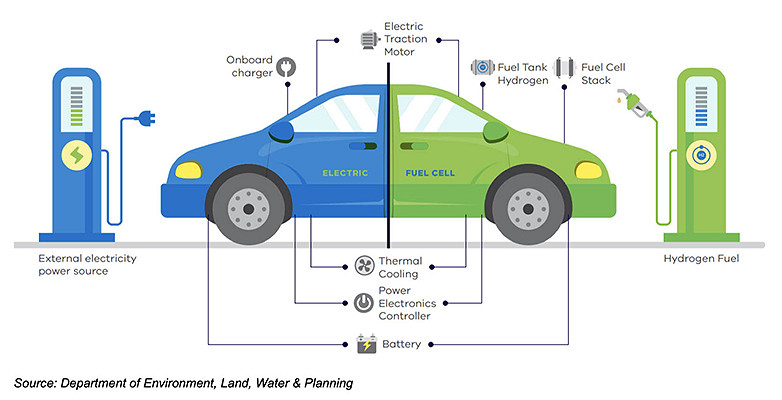
The phrase “electric cars killed the hydrogen car” is often thrown around to explain how electric vehicles (EVs) have become the dominant force in the auto industry, essentially leaving hydrogen fuel cell vehicles behind. But it’s not so much a “death” as it is a shift in priorities driven by a few key factors.
Infrastructure Issues
First and foremost, electric cars are just much more practical for everyday use. With EVs, you can charge your car with home EV chargers, and with the rapid expansion of charging infrastructure, it’s easier than ever to find a charging station when you’re on the road. It’s not perfect everywhere, but it’s getting there. Infact Australia is deploying more EV chargers than EV sale growth with a 4x increase in installed capacity year on year. Hydrogen cars, however, face a significant challenge: the refuelling infrastructure is still very limited and expensive to build. There just aren’t enough hydrogen stations, so even if you’re driving a hydrogen car, you might be worrying about where the next refuel is coming from. This makes EVs far more appealing to the average consumer.
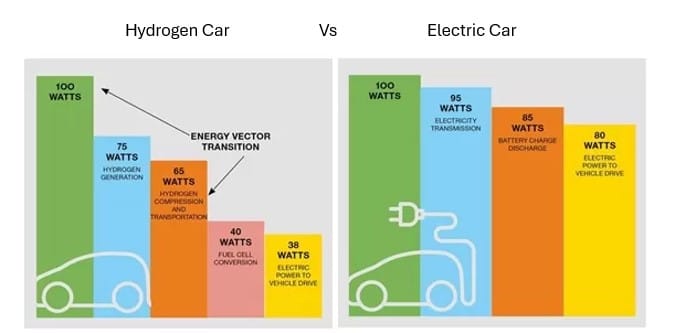
Efficiency and Energy Conversion
Then there’s the efficiency factor. Electric vehicles are inherently more energy-efficient than hydrogen cars. With an electric car, you’re essentially using electricity directly to power the motor, whereas hydrogen fuel cells require several stages of energy conversion. his lengthy process required to produce Hydrogen requires electricity. Then this hydrogen which needs to be pumped into the vehicles needs to be converted back into electricity to power the car. This makes the whole process less efficient than simply charging a battery.
It’s Cheaper to own an EV
Cost is another major reason with battery prices having dropped significantly, and there are more affordable options on the market. On the flip side, hydrogen vehicles are still quite costly to produce. The technology isn’t cheap, and the need for hydrogen refueling stations adds extra costs. So, while EVs have become more accessible, hydrogen cars still carry a hefty price tag, both in terms of the vehicle itself and the infrastructure needed to support them.
The environment prefers EV’s
The environmental impact also comes into play. While hydrogen cars have the potential to be a clean option, the reality is that a lot of hydrogen is still produced using fossil fuels, especially natural gas. There are efforts to produce “green” hydrogen from renewable sources, but it’s not the norm yet. Electric vehicles, on the other hand, are much cleaner, especially if they’re powered by renewable energy like wind or solar. The energy required to produce Hydrogen and then convert it back means you need more electricity generation. This has an environmental impact
The People have spoken
And of course, there’s the sheer momentum behind electric cars. Governments around the world are offering incentives for EVs, car manufacturers are heavily investing in electric technologies, and consumers are increasingly leaning toward cleaner, more efficient options. While hydrogen still has a place in certain sectors like heavy-duty transport, for consumers, electric vehicles have become the clear frontrunner.
So, while hydrogen fuel cell vehicles aren’t “dead” and still have some niche applications, it’s clear that electric cars have taken over. They’re cheaper, more efficient, and simply easier to use, which is why they’ve become the future of personal transportation.
-
Sam Korkees is the Co-Founder of EVSE Australia, a leading provider of electric vehicle (EV) charging infrastructure and solutions. Since co-founding the company in 2014 alongside Brendan Wheeler, Sam has played a pivotal role in scaling EVSE from an early-stage startup into a nationally recognised leader in EV charging.
EVSE has delivered some of the country's largest EV fleet and depot charging deployments, supporting the electrification of commercial fleets, logistics operations, and government assets. The company is also recognised as a leader in public charging infrastructure, with extensive experience in the rollout of fast and ultra-fast DC charging networks nationwide.
Sam works closely with government, utilities, and enterprise clients to design and implement scalable, future-ready charging solutions, helping accelerate the adoption of EVs across Australia.
Credentials: 11 years of EV charging deployment history, EV specialist, EV driver, member of AFMA, AEVA, EV Council, HVIA