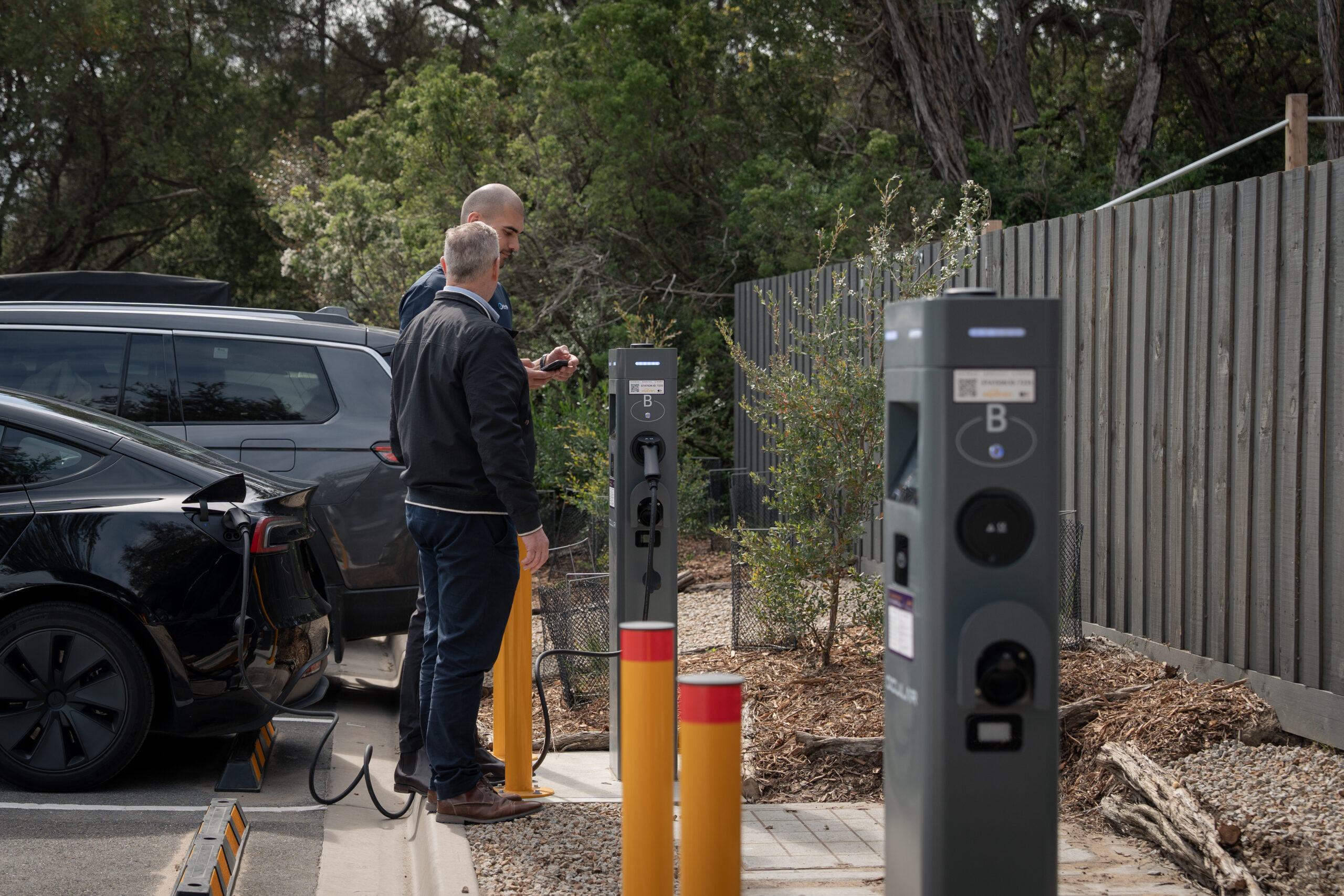
The best commercial EV charger for an Australian business is one that matches your fleet size, daily vehicle usage, power supply, and budget. For most small to medium businesses, a 7kW to 22kW AC smart charger with OCPP software integration is the right choice. Larger fleets and depots with high vehicle turnover may require DC fast chargers from 20kW up to 1MW. There is no single answer, but this guide covers every scenario.
- AC chargers (7kW to 22kW) suit most workplaces, hotels, retail sites and smaller fleets — lower cost, overnight or day charging
- DC fast chargers (20kW up to 1MW) suit fleet depots, service stations and high-turnover sites needing rapid turnaround
- OCPP (Open Charge Point Protocol) compliance is essential for billing, access control and fleet software integration
- Three-phase power is required for chargers above 7kW — confirm your site supply before selecting hardware
- Load management software is non-negotiable for any site installing more than two or three chargers simultaneously
- All commercial charger installations must comply with AS/NZS 3000 Wiring Rules and AS/NZS 3018 EV charging standard
Step 1: Understand What Your Business Actually Needs
Before comparing charger brands or specifications, answer these four questions. They will determine which charger type is right for your business.
| Question |
Why It Matters |
| How many vehicles need charging per day? |
Determines whether AC or DC charging is more practical — and how many charge points you need |
| How long are vehicles parked on site? |
Long dwell times (8+ hrs) suit AC charging. Short stops under 2 hours typically require DC fast charging. |
| Do you have three-phase power? |
Required for chargers above 7.4kW. Single-phase sites are limited to 7kW without an upgrade. |
| Do you need billing or access control? |
If staff, customers or fleet vehicles need separate billing, you need OCPP-compliant smart chargers. |
The two main types of commercial EV charger
AC Chargers: 7kW to 22kW
AC chargers are the standard choice for workplaces, car parks, hotels, retail centres, and smaller fleets. They deliver between 7kW and 22kW of power, which translates to roughly 40 to 120km of driving range added per hour of charging.
They are significantly cheaper to purchase and install than DC fast chargers, require less electrical infrastructure, and are well suited to any site where vehicles are parked for two hours or more.
- 7kW single-phase: Suits small offices, staff car parks, and most standard electrical supplies
- 11kW three-phase: Common in workplaces with three-phase supply and moderate daily charging demand
- 22kW three-phase: Fastest AC option — ideal for higher-turnover commercial sites or fleet depots where vehicles have shorter dwell times
DC Fast Chargers: 20kW to 1MW
DC fast chargers convert power before it enters the vehicle, allowing much faster charging speeds. They are the right choice for fleet depots with high vehicle turnover, service station forecourts, public charging sites, and any location where vehicles cannot be parked for more than one to two hours.
Output ranges from 20kW at the entry level through to 1MW for heavy vehicle and large depot applications. A 50kW unit can add 150km to 200km of range in under an hour, while higher-powered units at 150kW and above can charge many EVs from 10% to 80% in as little as 20 to 30 minutes.
Cost Consideration
DC fast chargers cost significantly more to purchase and install than AC chargers, and require three-phase power, advanced electrical infrastructure, and in some cases council approval. Only choose DC if your operational requirements genuinely need rapid turnaround.
Key features to look for in a commercial EV charger
OCPP Compliance
OCPP (Open Charge Point Protocol) is the industry-standard communication protocol that allows chargers to connect to a central management platform. For any commercial installation, OCPP compliance is essential. It enables remote monitoring, access control via RFID card or app, per-session billing, energy reporting, and integration with fleet management software. Without OCPP, you cannot accurately bill individual users, restrict access, or track energy consumption across a fleet. Always confirm OCPP 1.6 or 2.0 compliance before purchasing commercial chargers.
Load Management Compatibility
Any site installing more than two or three chargers needs a load management system. This software prevents multiple chargers from drawing peak power simultaneously and overloading the building’s switchboard. Expert guidance from a 2026 fleet panel confirms that if you have more than 10 EV chargers in one place, load management is what you need to be using. Load management systems can prioritise vehicles with the lowest charge, distribute available power dynamically across all chargers, and integrate with solar or battery storage to reduce grid demand and electricity costs.
Weatherproofing and Australian Climate Rating
Commercial chargers installed outdoors in Australia must have a minimum IP54 rating for dust and water resistance. For coastal locations or sites exposed to salt air, a higher IP65 rating is recommended. Always verify the charger’s maximum operating temperature, as many imported chargers are not rated for the 40 to 50 degree Celsius conditions common in Australian summers.
Tethered vs Untethered
Tethered chargers have a cable permanently attached, which is more convenient for public-facing or shared sites where users may not carry their own cable. Untethered chargers require users to bring a Type 2 cable, which is more common in staff-only or fleet settings where consistent cables are already available.
Recommended chargers by business type
| Business Type |
Recommended Charger |
Key Reason |
| Small office or workplace (1 to 5 vehicles) |
7kW AC smart charger — Ocular IQ Wallbox |
Low cost, easy install, single or three-phase, OCPP compliant |
| Medium workplace (5 to 20 vehicles) |
11kW or 22kW AC with load management — Ocular IQ Commercial |
Handles multiple simultaneous charges, OCPP billing, fleet software integration |
| Fleet depot (20+ vehicles) |
22kW AC multi-bay with smart load management |
Overnight depot charging, load sharing, OCPP fleet tracking |
| Retail or hospitality (customer charging) |
22kW AC tethered with RFID access |
Revenue-generating, customer-facing, pay-per-use billing |
| Service station or high-turnover site |
DC fast charger 50kW to 1MW |
Rapid turnaround under 30 to 45 minutes per vehicle |
| Public car park |
Mix of AC 22kW and DC 50kW |
Suits varied dwell times across different vehicle types |
What does commercial EV charger installation cost?
Installation costs vary significantly depending on the number of chargers, site electrical condition, and whether three-phase power is already available.
| Scenario |
Estimated Install Cost |
Notes |
| Single 7kW AC charger, simple install |
$900 to $1,300 |
Existing single-phase supply, short cable run |
| Single 22kW AC charger, three-phase |
$1,500 to $2,500 |
Three-phase supply required, switchboard check needed |
| 4 to 6 AC chargers with load management |
$8,000 to $20,000 |
Includes load management hardware and switchboard works |
| DC fast charger 50kW |
$25,000 to $50,000 |
Three-phase supply, DNO approval, civil works often required |
| DC fast charger 150kW+ |
$80,000 to $150,000+ |
Significant electrical infrastructure, may require grid upgrade |
Note on Government Grants
Government grant programs for commercial EV charging installations are available at both federal and state level, but change regularly. Contact EVSE Australia for the most current grants applicable to your project and location.
Recommended products from EVSE Australia
EVSE Australia commercial charger range
| Ocular IQ Wallbox |
Smart AC charger for small to medium workplaces. Single or three-phase,
OCPP compliant, app control, load management ready. Ideal for indoor or
covered installations. |
| Ocular IQ Commercial |
Multi-bay workplace and commercial site solution. 22kW three-phase,
OCPP software integration, billing, access control and load management.
Best for outdoor installations due to its heavy duty metallic design. |
| DC Fast Chargers |
For fleet depots and high-turnover commercial sites. Output from 20kW
up to 1MW. Contact EVSE for a site assessment and sizing recommendation. |
Frequently Asked Questions
Do I need three-phase power for commercial EV chargers?
For chargers above 7.4kW, yes. Most commercial chargers at 11kW or 22kW require a three-phase power supply. A licensed electrician can assess your site and advise whether an upgrade is needed, and what it will cost.
What is OCPP and why does it matter for businesses?
OCPP (Open Charge Point Protocol) is the standard that allows chargers to communicate with fleet management and billing software. Without it, you cannot accurately bill users, restrict access, or track energy data across multiple vehicles. It is essential for any commercial installation.
How many chargers does my business need?
A good starting point is one charger per two to three vehicles if overnight charging is available, or one charger per vehicle if daily turnover is high. An EVSE consultant can help you size the installation correctly based on your specific fleet and usage patterns.
Can I get government funding for commercial EV charger installation?
Yes. Federal and state government grant programs offer co-funding for eligible commercial EV charging installations, but programs change regularly. Contact EVSE Australia for the most current and relevant grants available for your project.
What maintenance do commercial EV chargers require?
Smart commercial chargers with OCPP connectivity can be monitored remotely, with automatic alerts for faults or offline status. Physical inspections are recommended annually. EVSE Australia offers ChargeAssure maintenance packages for commercial installations.
Ready to choose the best EV charger for your site? Get expert advice and a custom quote.