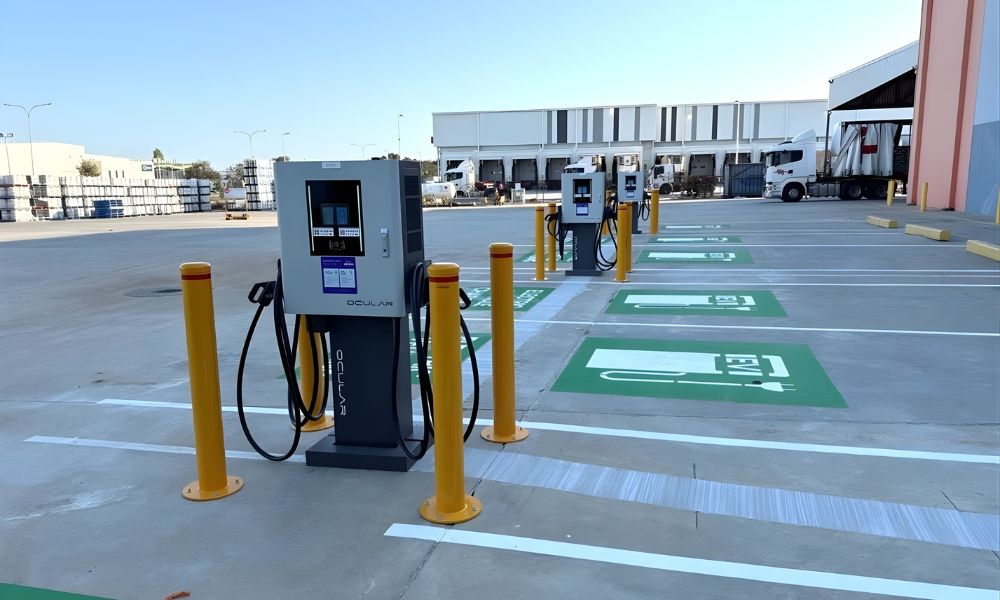
Building an EV charging strategy for a fleet of 10 or more vehicles requires more than just installing chargers. It involves mapping vehicle usage patterns, assessing depot electrical capacity, selecting the right charger mix, and implementing fleet management software to control costs and ensure every vehicle is charged and ready when needed. Done correctly, a fleet EV charging strategy can dramatically reduce fuel and maintenance costs while meeting your organisation’s emissions reduction commitments.
- EV price parity with internal combustion engine vehicles has arrived in Australia as of 2025, making fleet electrification financially compelling
- Overnight depot charging on AC is sufficient for most urban and suburban fleet vehicles — DC fast charging is rarely needed for standard car fleets
- Smart load management is essential for any depot with more than 10 chargers to prevent switchboard overload and peak demand charges
- Battery-buffered charging systems allow depots to charge from the grid slowly and discharge quickly into vehicles, solving grid capacity limitations
- Home charging for tool-of-trade vehicle drivers can dramatically reduce depot infrastructure costs and administrative complexity
- Federal and state government grant programs are available for eligible fleet charging infrastructure — contact EVSE Australia for the most current options
The Five Steps To A Fleet Ev Charging Strategy
Step 1: Audit Your Fleet and Usage Patterns
Understand how vehicles are used, how far they travel daily, and how long they are parked.
Step 2: Assess Your Depot and Site Electrical Capacity
Determine what your existing electrical infrastructure can support before selecting chargers.
Step 3: Choose Your Charging Model
Decide between depot charging, home charging, or a hybrid approach based on your fleet type.
Step 4: Select Charger Hardware and Fleet Software
Choose OCPP-compliant chargers with load management and fleet reporting capabilities.
Step 5: Plan for Growth and Future-Proofing
Size your infrastructure for the fleet you will have in five to ten years, not just today.
Step 1: Audit Your Fleet And Usage Patterns
The foundation of any fleet EV charging strategy is understanding how your vehicles are actually used. Many fleets overestimate their daily range requirements and underestimate how much time vehicles spend parked — which directly affects what type of charging infrastructure they need.
For each vehicle category in your fleet, document the following:
- Average daily kilometres driven
- Typical departure and return times
- Where vehicles are parked overnight (depot, home, or street)
- Whether vehicles are used on a shift basis or assigned to individual drivers
- Peak operational periods — are all vehicles out simultaneously, or staggered?
Industry experience confirms that for tool-of-trade vehicles and pool cars travelling moderate daily distances, AC Level 2 charging is more than sufficient. Most urban fleet vehicles travel well under 150km per day, and a 7kW to 22kW AC charger will fully replenish a standard EV battery overnight.
Key Insight
Half of all EV owners in Australia use a standard powerpoint at least twice a week. For fleet vehicles returning to a depot each evening, even slow charging is effective — the goal is to rethink charging as a continuous background activity rather than a fuel stop.
Step 2: Assess Your Depot Electrical Capacity
Before committing to any charger hardware, a licensed electrician should assess your depot’s electrical infrastructure. This is the step most fleets skip — and it is the one that leads to costly surprises during installation.
The key factors to assess are:
In most cases, yes, you need approval. The fastest and easiest path is via an exclusive-use by-law, which permits you to modify your lot under certain conditions, such as using a certified electrician and meeting all safety regulations. If the installation involves common property such as shared wiring or walls, you will likely need a special resolution vote.
- Current switchboard capacity and whether additional circuits can be added
- Whether three-phase power is available or needs to be upgraded
- The number of chargers your existing supply can support without infrastructure upgrades
- Distance from the switchboard to proposed charging bays (long cable runs add cost)
- Whether local network distributor (DNO) approval is required for your planned load increase
Grid Limitations — A Growing Issue for Larger Fleets
Australia’s distribution networks are still catching up to the energy demands of widespread fast charging. If your depot’s grid connection cannot support your full fleet’s charging demand, battery-buffered charging systems are now available. These container-sized energy storage units charge slowly from the grid and discharge quickly into vehicles, allowing depots to electrify without waiting for grid upgrades.
Step 3: Choose Your Charging Model
Model A: Central Depot Charging
All vehicles return to the depot each night and charge from a central installation. This is the simplest model to manage and the most common for fleets with a fixed base of operations.
For depots with 10 or more chargers, load management software is essential. As experts confirmed at a 2026 fleet infrastructure panel: if you have more than 10 EV chargers in one place, load management is what you want to be using. The goal is to avoid costly switchboard upgrades by distributing charging intelligently, prioritising empty vehicles, and avoiding peak demand spikes.
- Best for: Fleets where all vehicles return to a single depot overnight
- Key requirement: Load management software, OCPP-compliant chargers, dedicated EV distribution board
Model B: Home Charging for Tool-of-Trade Vehicles
Drivers take fleet vehicles home and charge overnight on a home charger. This model significantly reduces depot infrastructure costs and is increasingly popular for smaller fleets and tool-of-trade setups. The ATO has set a flat reimbursement rate of 4.20 cents per kilometre for home-charged fleet EVs, making cost recovery straightforward without the need for separate electricity metering at each driver’s home.
- Best for: Fleets where drivers take vehicles home overnight — sales teams, service technicians, field workers
- Key requirement: Home charger installation for each driver, ATO-compliant reimbursement process, driver education
Model C: Hybrid Depot and Home Charging
A combination of depot chargers for vehicles that return each day and home chargers for staff who take vehicles home. This is the most flexible and scalable approach for mixed fleets.
- Best for: Mixed fleets with both depot-based and home-based drivers
- Key requirement: Clear policy on which drivers receive home chargers, depot chargers sized for vehicles that do not go home
Step 4: Select Charger Hardware And Fleet Management Software
Charger Hardware
For most car and light commercial vehicle fleets, 7kW to 22kW AC chargers are the right choice for depot installations. DC fast chargers are only needed if vehicles must be recharged during the working day with a turnaround time under one hour.
| Fleet Vehicle Type |
Recommended Charger |
Charging Time (Approx.) |
| Passenger EV (BYD Atto 3, Tesla Model 3, Hyundai Ioniq 6) |
7kW to 22kW AC |
4 to 8 hours for full charge |
| Light commercial EV (LDV eDeliver, Mercedes eSprinter) |
11kW to 22kW AC |
6 to 10 hours for full charge |
| Heavy commercial or long-range EV |
DC 50kW to 150kW |
45 minutes to 2 hours for 80% |
| Pool vehicles with high daily turnover |
DC 20kW to 50kW |
30 to 90 minutes top-up during shift |
Fleet Management Software
OCPP-compliant chargers connect to a central fleet management platform, giving fleet managers full visibility of charging activity across the entire fleet. Key capabilities to look for include:
- Real-time charging status for every vehicle in the fleet
- Automated charge scheduling to take advantage of off-peak electricity tariffs
- Per-vehicle energy consumption reporting for cost allocation and sustainability reporting
- Driver access control via RFID card or app — prevents unauthorised use
- Integration with existing fleet telematics or management systems
- Remote diagnostics and fault alerting
Step 5: Plan For Growth And Future-proofing
One of the most common and costly mistakes in fleet EV charging strategy is building for today’s fleet rather than tomorrow’s. EV adoption in Australian fleets is accelerating rapidly, and a depot designed for 10 chargers today may need to support 30 within three to five years.
Best practice for future-proofing a fleet depot includes:
- Installing backbone electrical infrastructure (conduit, cable trays, sub-boards) to all planned parking bays upfront, even if chargers are not installed immediately
- Sizing the main switchboard and supply connection for the full future load, not the current load
- Choosing a charger platform that supports software upgrades and additional hardware without full replacement
- Planning for solar and battery storage integration from the outset — energy costs are the primary ongoing operating cost of a charged fleet
- Considering Vehicle-to-Grid (V2G) capability in charger selection — new Australian standards published in August 2024 removed key barriers to V2G adoption, and fleet vehicles could become a significant grid asset
Depot Design is Now Energy Design
The way depot managers need to think is shifting from parking layout to energy layout. Every new EV entering a fleet adds a little more load to the depot. Planning ahead for that load is now as important as planning parking bays.
Recommended Products For Fleet Charging
EVSE Australia fleet charging solutions
| Ocular IQ Commercial |
Multi-bay depot solution. 22kW three-phase, OCPP integration, load
management, fleet reporting and access control. |
| Ocular IQ Wallbox |
Individual bay solution for smaller depots or home charging installations.
Single or three-phase, OCPP compliant, app control and smart scheduling. |
| DC Fast Chargers |
For high-turnover depots or fleets requiring rapid mid-shift recharging.
Output from 20kW up to 1MW depending on fleet requirements.
Site assessment required. |
Frequently Asked Questions
How many chargers does a fleet of 10 vehicles need?
A fleet of 10 vehicles using depot charging overnight typically needs 5 to 10 chargers, depending on how staggered departures are and whether all vehicles need a full charge each night. Load management software means you do not need one charger per vehicle in most cases.
Do fleet EVs need DC fast chargers?
For most passenger and light commercial vehicle fleets returning to a depot each night, AC chargers are sufficient. DC fast chargers are only needed if vehicles must be recharged mid-shift with a turnaround under one hour.
What is load management and why does a fleet need it?
Load management software controls how multiple chargers share the available electrical capacity at a depot. Without it, chargers can overload the switchboard during peak periods. For any depot with more than 10 chargers, it is essential to avoid costly infrastructure upgrades and peak demand electricity charges.
Can fleet drivers charge at home and get reimbursed?
Yes. The ATO has set a flat rate of 4.20 cents per kilometre for home-charged fleet EVs. Employers can reimburse drivers using this rate based on odometer readings, without needing separate electricity metering at each driver’s home.
What government funding is available for fleet EV charging?
Federal and state government grant programs offer co-funding for eligible fleet charging infrastructure, but programs change regularly. Contact EVSE Australia for the most current grants available for your project.
Take the next step in your EV journey with a tailored commercial charging quote.