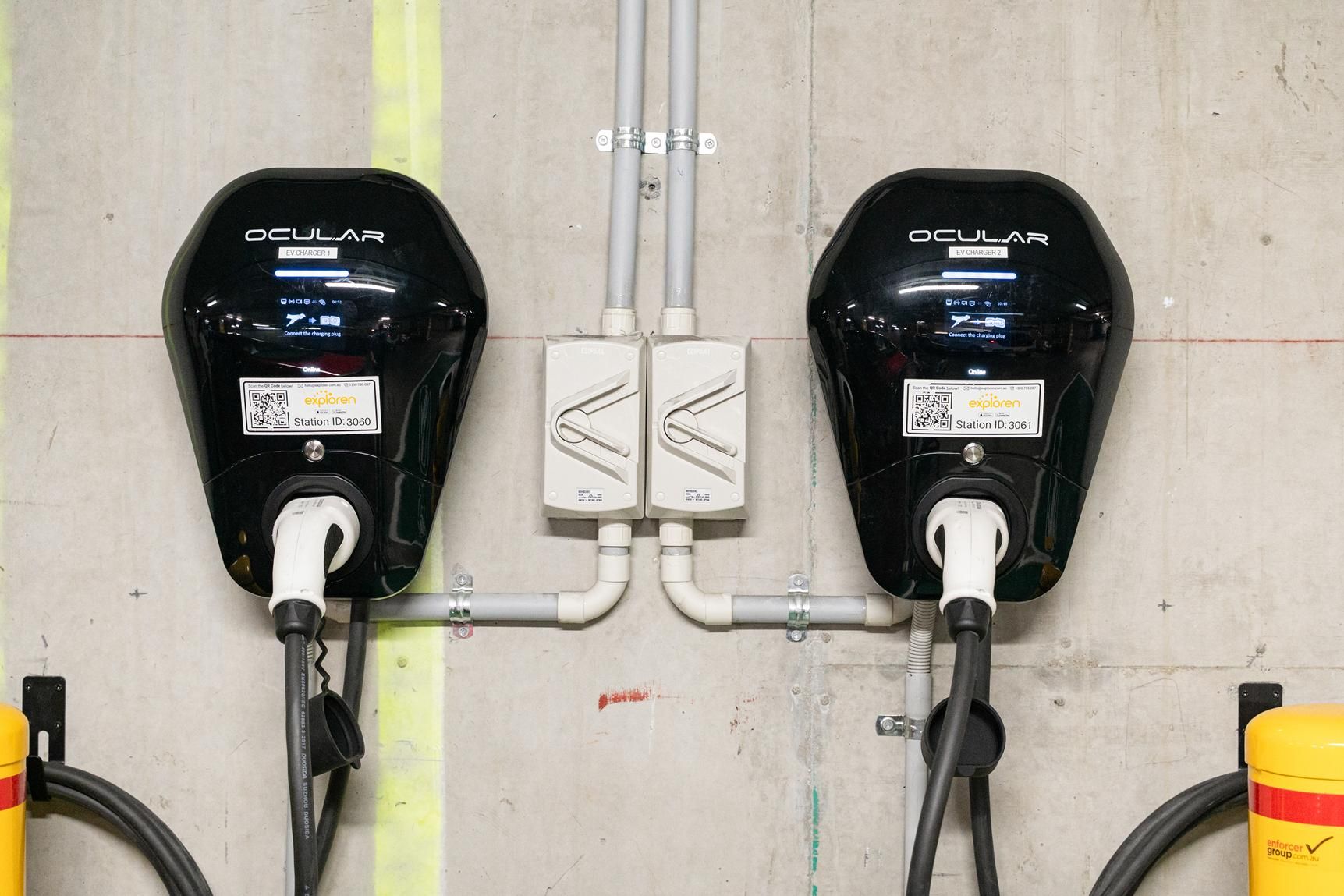
WHY STRATA BUILDINGS CANNOT AFFORD TO WAIT
For years, EV charging in apartment buildings was seen as a problem for later. That time has passed. With EV price parity now a reality in Australia and EVs comprising over 8 to 10 percent of new vehicle sales in 2025, residents are buying EVs now — and they are expecting their buildings to support them.
The consequences of inaction are becoming financial as well as practical. Buildings without EV charging infrastructure are already experiencing lower resale values, reduced rental premiums, and dissatisfied residents who feel their building is falling behind. Installing EV charging is increasingly viewed by buyers and tenants as a basic amenity, similar to secure parking or intercom access.
Future-proofing the building now is also significantly cheaper than retrofitting later. Backbone electrical infrastructure installed during a planned upgrade or renovation costs a fraction of what it will cost to thread conduit through a completed building in five years.
Market Reality
Tenant and buyer demand for EV-ready buildings is growing steadily. A lack of charging infrastructure can affect occupier satisfaction, resale value and rental premiums. The buildings that act early will hold a genuine competitive advantage in the residential property market.
The Legal Landscape In 2025 And 2026
New South Wales
NSW has the most advanced strata EV charging legislation in Australia. Under the Strata Schemes Management Act, EV charging is officially classified as Sustainability Infrastructure under Section 132B. This classification has two major practical effects.
First, a sustainability infrastructure resolution passes unless 50 percent or more of the value of votes cast are against it — effectively a simple majority, down from the previous 75 percent special resolution requirement. Second, from 1 July 2025, by-laws that previously blocked EV charger installations based solely on aesthetics are now prohibited. The only exception is for heritage-listed buildings or those in a heritage conservation area.
NSW owners corporations are now also mandated to consider environmental sustainability at every Annual General Meeting, with EV charging infrastructure required to be included in Capital Works Fund planning.
Challenging a Refusal
If an owners corporation unreasonably refuses an
EV charger installation request, the lot owner can challenge the decision at the NSW Civil and Administrative Tribunal (NCAT). The 2025 legislative changes make it significantly harder for committees to refuse without valid grounds.
Victoria
Victoria has not passed a standalone right-to-charge law, but has leaned heavily on the National Construction Code 2022. Since May 2024, all new apartment buildings must be EV Ready. For older buildings, the Victorian Government’s 2025 guidelines have streamlined the exclusive use by-law process for individual lot charging installations.
Queensland
Queensland operates under body corporate legislation, where ordinary resolutions apply to minor works and special resolutions to major works. The Queensland Government’s Zero Emission Vehicle Strategy sets a target of 50 percent zero emission vehicle sales by 2030, which is driving updated guidance for body corporate committees on EV charging approvals.
Other States and Territories
SA, WA, TAS and ACT each have their own strata legislation. In general, all states are moving toward simplified approval processes for sustainability infrastructure in line with the federal government’s National Electric Vehicle Strategy. Always check current state-specific legislation or seek legal advice before proceeding.
| State |
Classification |
Vote Threshold |
Key 2025 Update |
| NSW |
Sustainability Infrastructure |
Simple majority (50%) |
Aesthetic-based refusals now banned from 1 July 2025 |
| VIC |
Common property works |
Special resolution for major works |
NCC 2022 mandates EV Readiness for new builds from May 2024 |
| QLD |
Body corporate resolution |
Ordinary for minor, special for major works |
Zero Emission Vehicle Strategy targets 50% EV sales by 2030 |
| SA / WA / TAS / ACT |
Strata committee approval |
Varies by state legislation |
Check current state-specific rules |
Understanding Your Building’s Charging Options
Option 1: Individual Lot Chargers
Individual residents install their own charger in their allocated parking bay, billed through their own electricity meter. This is the simplest arrangement for both the resident and the owners corporation, as it requires minimal ongoing management once installed.
This approach works well in buildings where residents have individual distribution boards and deeded parking spots. It resolves billing complexity, as each resident’s charging is metered separately from the building’s common electricity.
- Pros: No owners corporation billing responsibility, simple metering, resident bears all costs
- Cons: Does not account for common power supply — multiple individual chargers without load management can trip circuits and cause outages for other residents
Market Reality
Tenant and buyer demand for EV-ready buildings is growing steadily. A lack of charging infrastructure can affect occupier satisfaction, resale value and rental premiums. The buildings that act early will hold a genuine competitive advantage in the residential property market.
Step 5: Plan For Growth And Future-proofing
One of the most common and costly mistakes in fleet EV charging strategy is building for today’s fleet rather than tomorrow’s. EV adoption in Australian fleets is accelerating rapidly, and a depot designed for 10 chargers today may need to support 30 within three to five years.
Best practice for future-proofing a fleet depot includes:
- Installing backbone electrical infrastructure (conduit, cable trays, sub-boards) to all planned parking bays upfront, even if chargers are not installed immediately
- Sizing the main switchboard and supply connection for the full future load, not the current load
- Choosing a charger platform that supports software upgrades and additional hardware without full replacement
- Planning for solar and battery storage integration from the outset — energy costs are the primary ongoing operating cost of a charged fleet
- Considering Vehicle-to-Grid (V2G) capability in charger selection — new Australian standards published in August 2024 removed key barriers to V2G adoption, and fleet vehicles could become a significant grid asset
Important
Installing individual chargers without a building-level load management plan is a common mistake that leads to switchboard overloads as more residents add chargers over time. Even for individual lot installations, a building-wide capacity assessment is recommended.
Option 2: Shared Common Property Chargers
The owners corporation installs shared chargers in the common car park, managed through a booking system or OCPP smart charger software. Residents pay per session, and the building controls access. This option works well for medium-sized buildings where not all residents have EVs yet, and where the owners corporation wants a managed, scalable solution. Visitor bays can be converted to shared EV charging bays as demand grows.
- Pros: Scalable, revenue-generating for the building, professional management software available
- Cons: Requires ongoing management, booking systems add administrative complexity, visitor parking is reduced
Option 3: Whole-of-Building Infrastructure Upgrade
For large buildings with 100 or more lots, a whole-of-building approach installs backbone electrical infrastructure throughout the car park — conduit, cable trays and sub-boards — so that chargers can be added to any bay in the future without major additional works. This is the most future-proof approach and the one recommended by most EV charging infrastructure specialists for larger buildings. The upfront investment is higher, but the long-term cost of not doing it is significantly greater when retrofitting becomes necessary in five to ten years.
- Pros: Future-proof, lowest long-term cost, ready for 100% EV uptake
- Cons: High upfront capital cost, requires special levy or capital works fund planning
Technical Requirements: What Your Building Needs
Electrical Capacity Assessment
Before any installation, a licensed electrician must assess the building’s main switchboard, sub-board capacity, and existing wiring to determine what the building can support and what upgrades are needed.
Dedicated EV Distribution Board
The National Construction Code requires that a dedicated EV distribution board be installed for significant renovations where EV chargers are being installed. This board is designed to handle the unique electrical demands of multiple EV chargers simultaneously, preventing overloads and ensuring safe operation as more chargers are added over time.
Load Management System
Any building installing more than two or three chargers needs a load management system. This software controls how chargers share available electrical capacity, prioritises vehicles with the lowest charge, and prevents peak demand spikes that would overload the building’s supply. Without load management, a building with five or more chargers risks tripping circuits and causing power outages for other residents.
Energy Management and Billing Software
For shared common property chargers, an energy management platform is essential to track individual resident usage and recover electricity costs fairly. OCPP-compliant chargers connect to platforms that monitor each charging session, generate usage reports, and handle automated billing — preventing disputes and ensuring the owners corporation does not subsidise individual residents’ charging costs.
| Building Size |
Minimum Technical Requirements |
| Small (under 10 lots) |
Individual metered circuits per bay, basic load management if 3+ chargers |
| Medium (10 to 50 lots) |
Dedicated EV distribution board, smart load management, OCPP billing software |
| Large (50 to 100 lots) |
Full backbone infrastructure, centralised energy management platform, staged rollout plan |
| Very large (100+ lots) |
Whole-of-building infrastructure strategy, battery buffer storage consideration, DNO engagement |
Addressing The Most Common Committee Objections
Fire Safety Concerns
This is the most frequently raised objection, and the evidence does not support it. Data from insurance discussions with Australia’s largest strata insurer, CHU, confirms that allowing EV charging in strata schemes does not lead to rate or risk changes. There have been only 10 documented EV fires in Australia over 14 years, compared to more than 10 petrol and diesel vehicle fires per day. The Australian Building Codes Board has also confirmed that EVs and EV chargers in car parks are now common enough that they are no longer classified as a special hazard under the National Construction Code.
Insurance Premium Increases
Insurance underwriters, including CHU — the largest strata insurer in Australia — have confirmed that standard EV charging installations by licensed contractors do not increase insurance premiums. Proper installation to code and by-law requirements is the key condition.
Cost and Who Pays
In strata buildings, the initial installation of circuit breakers, EV distribution boards and shared cables is generally covered by the owners corporation through the capital works fund or a special levy. Residents who install a personal charger in their parking bay cover the final connection and charger hardware costs. Government grant programs can help with the initial setup — contact EVSE Australia for current options. Incremental levy models can also spread the cost over several years.
What Government Support Is Available?
- NSW: State government grant programs for strata EV charging co-funding are available. Contact EVSE Australia or check energy.nsw.gov.au for current program status.
- VIC: Sustainability Victoria grants and Victorian Government guidelines for apartment buildings. Check sustainability.vic.gov.au.
- QLD: Zero Emission Vehicle Strategy incentives. Check qld.gov.au/transport/ev.
- Federal: Federal government grant programs for strata EV charging infrastructure. Contact EVSE Australia for the most current grants available.
Recommended Products For Strata And Multi-tenancy Buildings
Evse Australia Strata And Apartment Solutions
| Ocular IQ Commercial |
OCPP-compliant shared charger for common property. Supports billing,
access control and load management. Ideal for medium to large strata buildings. |
| Ocular IQ Home Solar |
Smart home charger for individual lot owners. Solar-compatible with three
modes (Solar Only, Solar Assist and Grid), app-controlled, load management
ready. Suits buildings with individual distribution boards. |
| Ocular IQ Wallbox or IQ Commercial |
IQ Wallbox suits indoor or covered bay installations. IQ Commercial is best
for outdoor exposed car parks due to its heavy duty metallic design for all
climates. Both support OCPP billing, access control and load management. |
| Exploren Software |
EVSE’s cloud-based charging management platform — monitors individual
resident usage, handles automated billing and provides real-time reporting
for strata managers. |