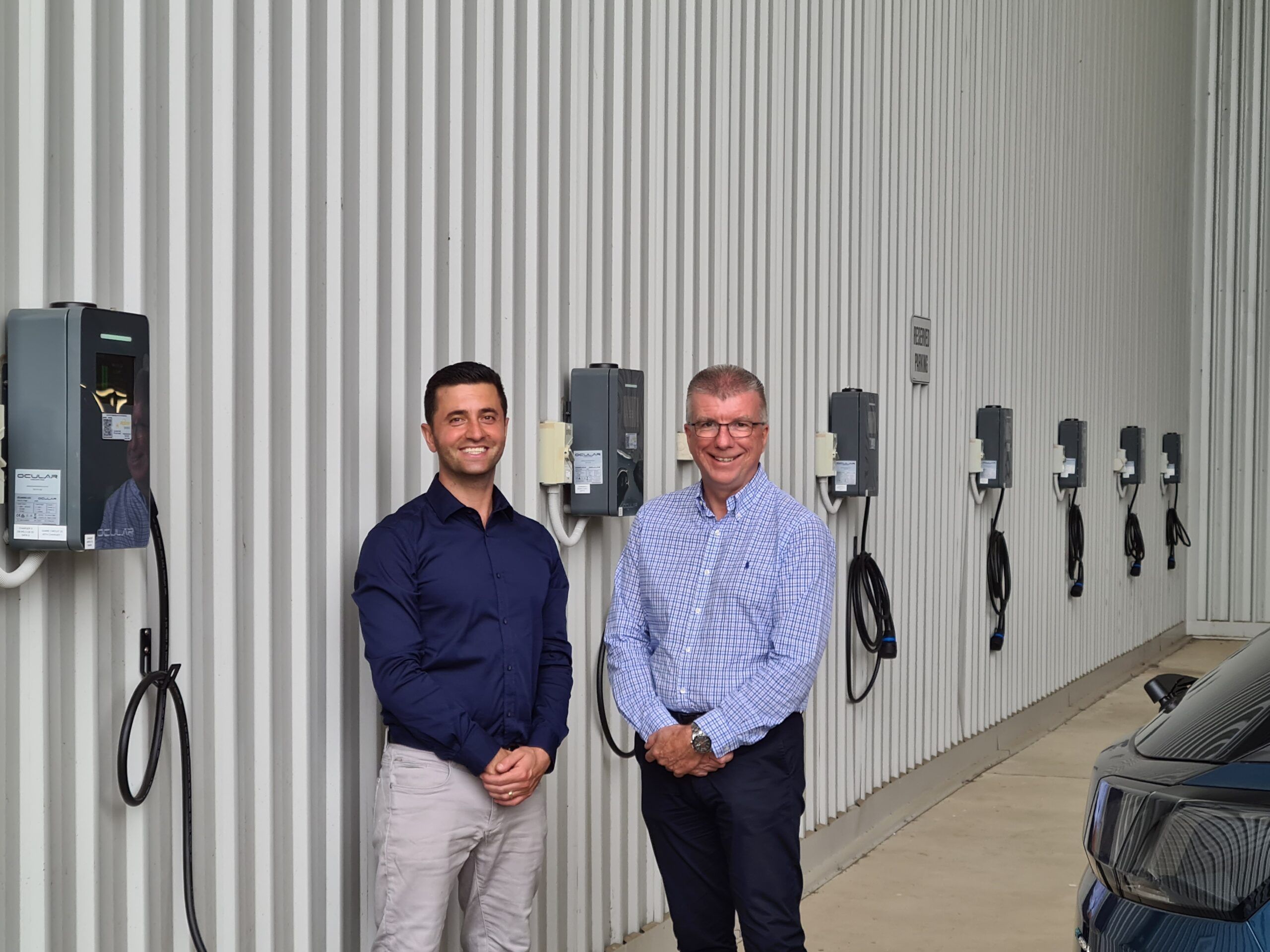
Setting up EV charging for a car park or apartment building involves four key steps: assessing your building’s electrical capacity, getting strata or owners corporation approval, selecting the right charger type and load management system, and arranging a compliant installation by a licensed electrician. The process is more straightforward than most committees expect, and recent law changes have made it significantly easier for residents and property managers to get approvals across the country.
- In NSW, EV charging is now classified as Sustainability Infrastructure, requiring only a simple 50% majority vote rather than the previous 75% special resolution
- From 1 July 2025, owners corporations cannot ban EV charger installations on aesthetic grounds alone, unless the building is heritage listed
- Since May 2024, all new apartment builds in Victoria must be EV Ready under the National Construction Code 2022
- All installations must comply with AS/NZS 3000 Wiring Rules and be completed by a licensed electrician
- Load management is essential in multi-bay settings to prevent switchboard overload
- State and federal government grant programs are available to co-fund apartment and car park EV charging — contact EVSE Australia for the most current options
The four steps at a glance
Step 1: Assess Electrical Capacity
Understand your switchboard capacity, phase availability and cable run distances before selecting chargers.
Step 2: Get Strata or Owners Corporation Approval
Prepare a formal proposal with cost estimates, a load management plan and a draft by-law.
Step 3: Choose the Right Charging Setup
Select individual bays, shared common property chargers, or a whole-of-building infrastructure approach.
Step 4: Installation, Compliance and By-Laws
Engage a licensed electrician, obtain certificates of compliance, and finalise the strata by-law.
Step 1: Assess Your Building’s Electrical Capacity
Before selecting chargers or raising a motion with your strata committee, a basic electrical assessment is essential. Most apartment buildings and commercial car parks built before 2020 were not designed with EV charging in mind, and the existing switchboard may not support multiple chargers running simultaneously.
A licensed electrician or EV charging consultant should assess the following:
- Current switchboard capacity and whether it can support additional circuits
- Whether three-phase power is available or needs to be upgraded
- Distance from the switchboard to the proposed charging locations (longer cable runs increase cost)
- Number of car spaces that may require charging now and in the next five to ten years
- Whether load management software will be needed to prevent peak demand issues
For apartments and townhouses with individual distribution boxes and metering, it may be possible to simply add an additional circuit or reuse an existing one. Load control may be required to manage the overall building load once chargers are installed.
Tip: Apply for a Feasibility Study Grant First
Government grant programs in several states co-fund the cost of a formal EV charging feasibility study for apartment buildings. Getting this done before approaching your committee gives your proposal a professional foundation and significantly increases approval rates. Contact EVSE Australia to find out what is currently available in your state.
Step 2: Get Strata Or Owners Corporation Approval
This is the step most residents and committees find daunting, but the legal landscape has shifted considerably in favour of EV charging in 2025.
What Approval Do You Need?
In most cases, yes, you need approval. The fastest and easiest path is via an exclusive-use by-law, which permits you to modify your lot under certain conditions, such as using a certified electrician and meeting all safety regulations. If the installation involves common property such as shared wiring or walls, you will likely need a special resolution vote.
| State |
Approval Required |
Vote Threshold |
| NSW |
Yes, for common property works |
Simple majority (50%) for sustainability infrastructure |
| VIC |
Yes, owners corporation approval |
Special resolution (75%) for works over $30,000 |
| QLD |
Yes, body corporate approval |
Ordinary resolution for minor works; special for major |
| SA / WA / TAS / ACT |
Yes, strata committee approval |
Varies by state legislation; check local rules |
Heritage-Listed Buildings
Owners corporations in states with the 2025 strata reforms in place cannot refuse EV charger installations on aesthetic grounds alone. However, if your building is heritage listed, additional planning approvals may be required regardless of the strata vote outcome.
How to Put the Proposal Together
Approaching a strata committee with a well-prepared proposal significantly increases the likelihood of approval. A strong proposal should include:
- The feasibility study or electrical assessment report
- A cost estimate from a qualified EV charging installer
- A proposed by-law covering installation, maintenance, electricity billing and access rules
- A load management plan showing the installation will not overload the building’s electrical system
- Information on available government grants or funding options
Note on By-Laws
More progressive buildings are moving towards managed permissions, setting rules about who can install chargers, how they must be maintained, and how shared electricity is measured. A well-drafted by-law should spell out how residents access the charger, how fees are charged, and what happens if it needs repairs or upgrades.
Step 3: Choose The Right Charging Setup For Your Building
There is no one-size-fits-all solution for apartment and car park charging. The right setup depends on building size, parking configuration, budget, and how many residents are likely to need charging in the coming years.
Option A: Individual Charging at Dedicated Car Spaces
Each resident installs their own charger at their allocated car space, billed through their individual electricity meter. This approach works well in smaller buildings where residents have deeded parking spots and individual distribution boards. This is best suited to apartments and townhouses with individual distribution boxes and metering similar to a standalone house. It resolves questions of access or usage charges, as EV charging is included in the resident’s existing meter and electricity billing.
Option B: Shared Chargers on Common Property
The owners corporation installs one or more shared chargers in the car park, managed through a booking system or smart charger app. Residents pay per use, and the building controls access. For medium buildings of 11 to 100 apartments, one or two charging modules would support around 12 EVs, which exceeds the estimated 10% uptake over 10 years. If there are sufficient car park spaces and the owners corporation can manage a scheduling system, a common property approach may be suitable. Many progressive buildings are now installing one or two high-speed 22kW chargers in visitor spots, with residents using an app to unlock the charger. The building can set a small electricity markup, meaning the EV chargers help offset communal electricity costs.
Option C: Whole-of-Building Infrastructure
For large buildings of over 100 apartments, a whole-of-building approach provides sufficient infrastructure to allow EV charging to be provided to each owner’s car space as required. This is a long-term investment aimed at future-proofing EV charging requirements. This involves installing backbone electrical infrastructure throughout the car park so individual chargers can be added to any bay in the future without major additional works. The upfront cost is higher, but long-term savings on retrofitting are significant.
Load Management: A Non-Negotiable for Multi-Bay Settings
Load management is the technology that prevents multiple chargers from drawing peak power simultaneously and overloading the building’s switchboard. In any building with more than two or three chargers, a load management system is essential. Smart load management solutions can integrate with kitchen or HVAC loads to shed non-critical loads if the total electrical draw is about to exceed safe limits. Circuit segregation keeps EV charger circuits separate from major appliance circuits to prevent competition for available power.
| Building Type |
Recommended Option |
Key Consideration |
| Small (under 10 units) |
Individual chargers at dedicated bays |
Individual metering keeps billing simple |
| Medium (11 to 100 units) |
Shared common property chargers |
Smart charger app for access and billing |
| Large (100+ units) |
Whole-of-building infrastructure |
Future-proof backbone reduces long-term retrofit cost |
| Commercial car park |
Shared chargers with OCPP billing software |
Revenue generation via pay-per-use model |
Step 4: Installation, Compliance And By-laws
Who Can Install the Chargers?
All EV charger installations in Australian apartment buildings and car parks must be carried out by a licensed electrician. Installations must comply with AS/NZS 3000 Wiring Rules and AS/NZS 3018 EV charging standard. Licensed electricians must provide a Certificate of Compliance on completion. If switchboard or meter room changes affect fire escape routes, a fire engineer may need to assess egress and heat loads.
What Should the By-Law Cover?
A comprehensive EV charging by-law for a strata building should address the following:
- Which car spaces are approved for charger installation
- Approved charger brands, types and power ratings
- Who is responsible for maintenance and repair costs
- How electricity costs are metered and billed to residents
- Access rules for shared chargers, including booking systems
- What happens if a charger needs to be removed or upgraded
What Does It Cost?
Costs vary considerably based on building size, switchboard condition, and the number of chargers being installed. As a ballpark guide for a 30-unit building wanting four shared chargers with load balancing, total costs including switchboard upgrades are typically in the range of $30,000 to $40,000. This can be recovered via a special levy spread across quarterly levies over five years.
Is Ev Charging In Apartments A Fire Risk?
This is the most common objection raised by strata committees, and the evidence does not support the concern. NRMA data shows only 13 EV fires between 2021 and 2026, compared to 11,582 internal combustion engine fires over the same period. EV chargers installed to Australian standards include ground-fault detection and over-current protection as standard. The risk profile of a properly installed Level 2 wall charger is comparable to any other high-draw appliance in the building. Having the right solution installed by certified installers does not increase fire insurance premiums and does not increase the overall fire safety risk of the building.
What Government Grants Are Available?
Several state governments and local councils offer financial assistance to increase the number of EV charging facilities in strata buildings. Check the following for current funding opportunities:
- NSW: State government grant programs for apartment and strata EV charging. Contact EVSE Australia or check energy.nsw.gov.au for current program status.
- VIC: Sustainability Victoria grants and the Victorian Government’s EV charging guidelines for apartment buildings
- QLD: Zero Emission Vehicle Strategy incentives for strata and commercial properties
- Federal: Federal government grant programs for strata EV charging infrastructure. Contact EVSE Australia for the most current grants available.
Recommended for car parks and apartment buildings
| Ocular IQ Commercial |
Supports OCPP software integration for billing, access control and load
management. Ideal for shared common property chargers in medium to large buildings. |
| Ocular IQ Wallbox or IQ Commercial |
For individual bay installations — IQ Wallbox suits indoor/covered bays,
IQ Commercial suits outdoor exposed car parks due to its heavy duty metallic
design for all climates. Both support OCPP billing and load management. |
| DC Fast Chargers |
For larger car parks or high-turnover commercial sites where rapid vehicle
turnaround is a priority. Output from 20kW up to 1MW depending on site requirements. |
Frequently Asked Questions
Can a strata committee refuse to allow EV charger installation?
They can raise objections, but since the 2025 strata reforms, owners corporations in NSW cannot refuse an installation on aesthetic grounds alone unless the building is heritage listed. In most states, EV charging is now classified as sustainability infrastructure, making it significantly harder to block outright.
Do I need a vote to install an EV charger in my apartment building?
In most cases, yes. If the installation touches common property such as shared wiring, walls or the car park floor, you will need strata or owners corporation approval. In NSW, a simple majority vote of 50% is now sufficient for most EV charging upgrades classified as sustainability infrastructure.
How many chargers does my building need?
A good starting point is planning for 10% of car spaces to have charging capability within the next five to ten years, and ensuring the backbone electrical infrastructure can accommodate future growth beyond that. An EVSE consultant can help size the installation correctly based on your building’s current and projected EV uptake.
What is load management and why does my building need it?
Load management is software that controls how multiple chargers share the available electrical capacity in a building. Without it, several chargers running at full power simultaneously could exceed the switchboard’s capacity. It is essential for any building installing more than two or three chargers.
Who pays for the electricity when residents charge their EVs?
This depends on the setup. With individual chargers at dedicated bays, residents pay through their own electricity meter. With shared common property chargers, buildings typically use a smart charger system where residents are billed per kilowatt-hour through an app, with the building recovering electricity costs plus any management fees.
Setting up EV charging for your building? Get a customised solution today.